
A commercial submission rarely arrives as data. It arrives as a broker email with an ACORD 125 attached, a general liability supplement, a statement of values in Excel, loss runs from three previous carriers in three different layouts, and sometimes a scanned financial statement. Before anyone can price the risk, someone has to turn that pile into fields a rating engine can read. That work is underwriting data extraction.
Often that someone is the underwriter. McKinsey estimates that in large commercial lines, 30 to 40 percent of an underwriter’s time goes to administrative work such as rekeying data or running analyses by hand. Brokers feel the drag from the other side. In Ivans’ 2026 survey of 702 independent agents, 90% said they had reduced the business they send a carrier because of friction around submissions.
This guide covers what underwriting data extraction involves for each of the three main document types, why loss runs are harder than ACORD forms, what a working intake pipeline looks like, and how to tell whether it is doing its job.
Key takeaways
- Underwriting data extraction turns ACORD forms, broker submission packages and loss runs into structured, validated fields that flow into clearance, rating and the underwriting workbench.
- ACORD forms are standardized, but they arrive in different editions, as flattened scans and with handwritten answers, so template OCR on its own breaks often.
- Loss runs have no industry-standard layout. Extraction has to map each carrier’s labels to one claim schema and check the arithmetic (paid plus reserves should equal incurred).
- Accenture puts a typical commercial submission at 300 to 500 pieces of information, of which manual intake may capture about 50. The other 450 or so stay locked in the documents.
- Track field-level accuracy, straight-through rate and time to quote, and keep every extracted value linked to the spot in the source document it came from.
What is underwriting data extraction?
Underwriting data extraction is the work of reading the documents in an insurance submission, pulling out the fields underwriters need, validating them, and delivering them as structured data to downstream systems. In commercial P&C the inputs are usually the broker’s email, ACORD applications and their line-of-business sections, schedules such as statements of values and vehicle or driver lists, loss runs, and supporting files like financials, inspection reports and expiring policies.
It happens at the front door of underwriting, between the shared inbox and the underwriting workbench. How well underwriting data extraction works decides how fast a submission is cleared, whether it reaches the right desk, and how much of the file an underwriter has to reread before quoting.
The size of the gap is easy to underestimate. Accenture has written that a typical commercial new business submission contains 300 to 500 pieces of information, and that a conventional intake process, often run by a lower-cost or offshore team entering a minimum set of fields, might convert about 50 of them into digital data “on a good day.” The rest stays in the PDFs as dark data, so pricing, appetite and portfolio models see only a fraction of what the broker sent.
For a wider view of how Compunnel works with carriers on data, claims and distribution, see our insurance industry solutions.
Why manual intake is still the bottleneck
Underwriters have been reporting the same time problem for years. In Accenture’s 2021 P&C underwriting survey, the average underwriter spent 40% of their time on administrative tasks, 30% on negotiation and sales support, and 30% on underwriting itself. Accenture’s 2024 survey of 430 underwriting executives across 11 countries found some improvement, yet non-core work still took more than a third of underwriters’ time.
Agents describe the same bottleneck. Ivans’ 2026 Insurance Agency-Carrier Connectivity Trends survey asked 702 independent agents what they want from carriers, and submission handling came out on top.
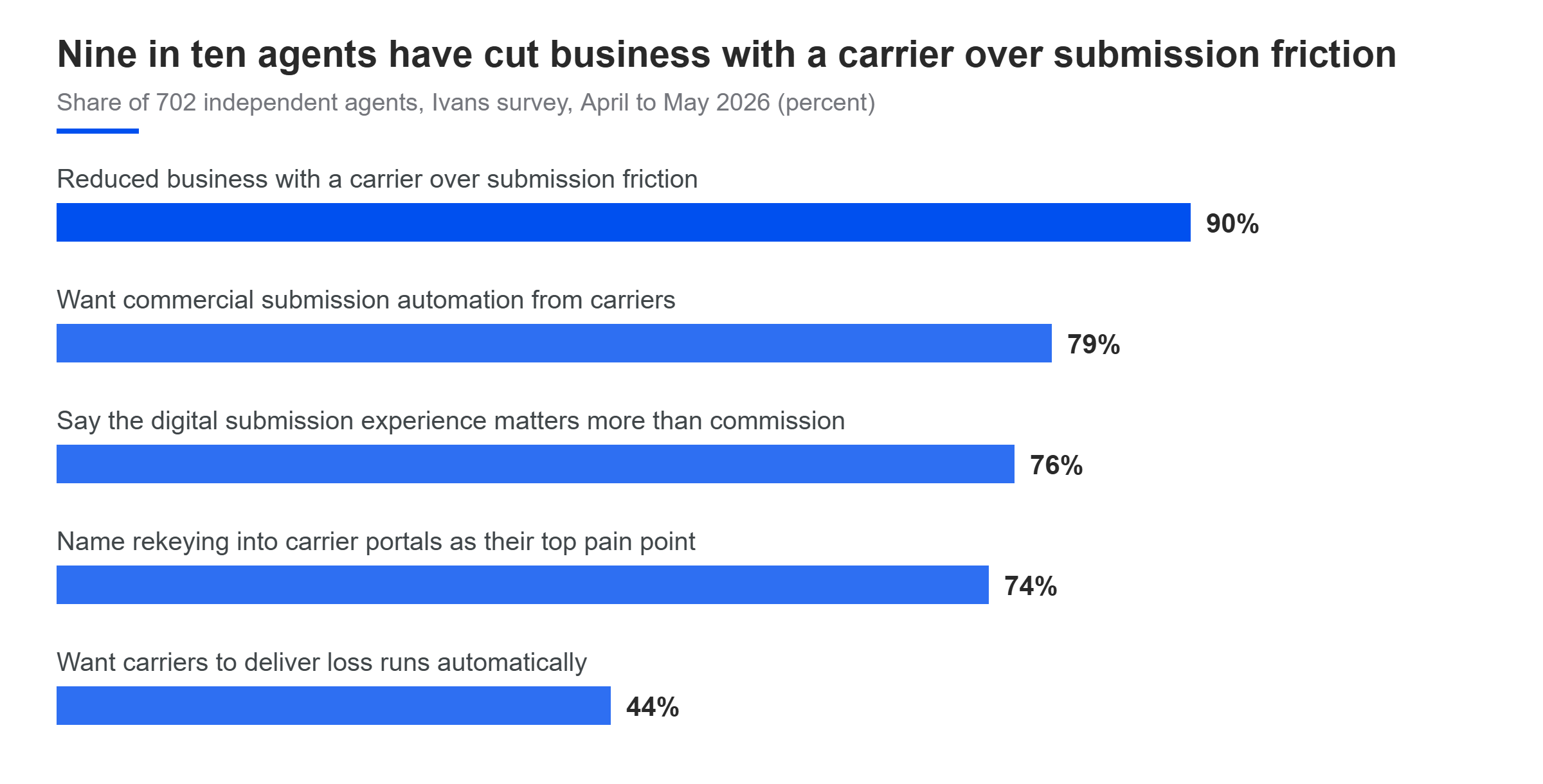
Commercial agencies rekey more than personal lines agencies (70% versus 62%), and 49% of commercial agencies still rely on email to send submissions, while 7% use dedicated submission software. With half of commercial agencies still emailing submissions, carriers will be reading unstructured packages for a while yet. The ones that read them quickly and accurately are the ones agents say they will send business to, and dependable underwriting data extraction is what makes that speed possible.
Extracting data from ACORD forms
ACORD forms are the closest thing commercial insurance has to a shared data layer, which makes them the easiest place to start with underwriting data extraction. The ACORD 125 commercial insurance application identifies the applicant, the business, its locations, prior carriers and the coverages requested. Line-specific sections attach to it, and the ACORD 130 workers’ compensation application can also stand alone for a monoline account.
| Form | What it covers | Fields underwriters usually need first |
|---|---|---|
| ACORD 125 | Commercial insurance application | Named insured, FEIN, entity type, SIC or NAICS code, description of operations, locations, prior carrier and premium, requested lines, effective date |
| ACORD 126 | Commercial general liability section | Limits, classification codes, exposure basis (payroll, sales or area), hazard questions, additional insureds |
| ACORD 140 | Property section | Building and contents values, construction, occupancy, protection class, year built, sprinklers, building improvements |
| ACORD 127 | Business auto section | Vehicle schedule, driver list, garaging locations, radius and use |
| ACORD 130 | Workers’ compensation application | Payroll and employee counts by class code, prior carriers, loss history |
A standard form still takes work to read reliably. These are the problems that come up most:
- Edition drift. Agency management systems and carriers run different editions of the same form, so a field can move from one version to the next. An extraction template built for one edition will misread another.
- Flattened and scanned PDFs. Many forms are printed, signed and scanned, or exported with the fillable fields flattened. There is no form data to read, only an image of a page.
- Checkboxes, handwriting and “see attached.” Yes or no hazard questions, hand-marked boxes and notes that point to an attachment all carry underwriting meaning and are easy to miss.
- Consistency across forms. The locations on the 125 should match the buildings on the 140. Payroll on the 130 should line up with the GL exposure on the 126 when both are payroll rated. Extraction should flag a mismatch instead of passing it along.
A workable approach reads the form’s own field data when a fillable PDF still has it, since that is fast and exact. When it doesn’t, the system recognizes which form and edition it is looking at, uses layout-aware OCR with a language model to read the page, and runs cross-form checks before anything reaches the workbench.
Extracting data from broker submission packages
The submission is everything around the forms, and the broker’s email is often the most current part of it: a changed effective date, a target premium, a note that the insured just added a location. Attachments come as PDFs, Excel schedules, Word narratives, images and zip files. One email may cover several accounts, and a follow-up email may change what the first one said. Underwriting data extraction here has to cope with all of it.
Here extraction is as much about sorting as reading. A typical intake flow runs in seven steps:
- Capture submissions from shared inboxes, broker portals and upload channels into one queue.
- Classify each package by splitting it into documents and labeling them: ACORD form, statement of values, loss run, financials, supplemental application or correspondence.
- Extract fields using the right logic for each document type, including the email body.
- Reconcile values across documents into one account record and resolve conflicts, such as a total insured value on the SOV that differs from the one on the ACORD 140.
- Check completeness and appetite by flagging missing documents, testing the risk against appetite rules, and routing it to the right desk or a decline.
- Enrich the record with third-party data such as firmographics, property characteristics or hazard scores.
- Deliver the structured record to the clearance system, rating engine or underwriting workbench, with links back to each source document.
Schedules deserve their own attention. In a property submission, the statement of values can list hundreds of locations and is usually the most data-dense document in the package. Column names change from broker to broker, so the job includes mapping columns to a standard schema, geocoding addresses, and translating construction and occupancy descriptions into the codes your models use. That can take more effort than reading the ACORD 140.
Our Enterprise Knowledge and Document AI practice covers the ingestion, classification and extraction layers of this flow.
Extracting data from loss runs
Loss runs are the hardest of the three for underwriting data extraction. A loss run is a carrier-issued report of the claims history on a policy, and unlike ACORD forms there is no universal template. Each carrier uses its own layout and labels, and one report may combine several policies or coverage lines.
The fields to capture fall into four groups:
- Report level: carrier, named insured, policy number, policy period, line of business and valuation date.
- Claim level: claim number, date of loss, date reported, status (open, closed or reopened), cause or type of loss, description, claimant for liability lines, and state.
- Financials: paid loss, paid expense, outstanding reserves, recoveries such as subrogation and salvage, and total incurred.
- Summary: claim counts and totals for each policy year.
Loss run extraction usually goes wrong in the same few places. Labels differ, so “paid loss” on one carrier’s report is “indemnity paid” on another’s, and expense may be listed separately or rolled into the total. Tables break across pages, individual claims wrap over several lines, and subtotals appear partway through a table. Some carriers print a single claim per page.
Currency is the next issue. Underwriters generally ask for currently valued loss runs, meaning the valuation date falls within 30, 60 or 90 days of the application, depending on the carrier. That makes the valuation date a field to extract and check. A “no losses” letter from a carrier also counts as a loss run and should produce a zero-claim record for that policy period rather than a gap.
A short set of validation rules catches most extraction errors:
- Paid plus reserves equals incurred, for each claim and in total, after accounting for how the carrier treats expense and recoveries.
- The date of loss falls inside the policy period and comes before the report date and the close date.
- Claim counts and dollar totals match the report’s own summary page.
- The policy periods across all carriers cover the requested experience period, commonly five years, without gaps.
Once loss runs are normalized, the analysis underwriters care about is fast: frequency and severity by year, large-loss flags, development on open claims, and loss ratios against premium. Agents want the same thing. In the Ivans 2026 survey, 44% of agents said they want carriers to deliver claims loss runs automatically.
Template OCR compared with AI document extraction
Template-based OCR works well on a fixed, known layout. It struggles with loss runs, where a carrier panel can mean dozens of formats, and with anything that changes without notice, such as a new ACORD edition or a broker’s custom SOV. Current document AI combines layout analysis, OCR and language models, so it can read a document it has not seen before and return a confidence score for each field. That is what separates modern underwriting data extraction from template OCR.
| Situation | Template or rules-based OCR | AI document extraction |
|---|---|---|
| Known fillable ACORD PDF | Accurate and fast | Accurate and fast |
| New ACORD edition | Needs a new template | Usually handles it; verify on a test set |
| Loss run from a new carrier | Needs a new template | Maps labels to the schema; review low-confidence fields |
| Email body and broker notes | Not supported | Extracts dates, premiums and changes from free text |
| Handwriting and checkboxes | Weak | Better, still needs review below a confidence threshold |
| Field confidence and source link | Rarely available | Standard in most platforms |
| Ongoing maintenance | Grows with every new format | Shifts to monitoring accuracy and retraining on errors |
AI extraction still makes mistakes, and a misread total insured value or incurred amount goes straight into pricing. Set a confidence threshold for each critical field, send anything below it to a reviewer, and make every value traceable to the exact place in the source document. That traceability is what lets an underwriter trust the data and lets an auditor check a decision later.
How to measure extraction accuracy and ROI
Measure underwriting data extraction at the field level. A wrong fax number and a wrong total insured value are not the same error, so weight the fields that feed rating, appetite and loss analysis most heavily. The metrics that matter:
- Field-level accuracy, by document type and by critical field.
- Straight-through rate, meaning the share of documents or fields that pass without a human touch.
- Review time per submission and number of touches.
- Time from receipt to clearance and from receipt to quote.
- Data completeness, meaning how many of the available fields you capture (the 50 versus 500 problem).
- Quote and hit ratios on the submissions that fit your appetite.
Before go-live, build a test set of real, labeled documents that covers your main carriers, brokers and form editions. Run it against every model, prompt or rule change so accuracy is measured instead of assumed. Our QE-X quality engineering team applies the same discipline to AI systems that it applies to core platforms.
Underwriting data extraction touches sensitive data, including FEINs, driver license numbers, claimant names and financials. Plan for access controls, an audit trail of every extraction and correction, and monitoring for accuracy drift. Our Responsible AI, Governance and Assurance practice covers this layer through ModelGuard™.
A practical roadmap for insurers
- Map current intake: submission volume by line and channel, where rekeying happens, and which fields underwriters actually use.
- Start with one line of business and one document type, such as ACORD 125 and 140 for a property desk or loss runs for a casualty team.
- Define the target schema and validation rules with underwriters as well as IT.
- Build the labeled test set and record today’s manual accuracy and handling time as a baseline.
- Pilot with human review on every field, then raise automation as accuracy is proven field by field.
- Integrate with clearance, rating and the workbench so nobody retypes the data at the next step.
- Add document types and lines, and feed the newly captured data into pricing and portfolio analytics.
Step 7 is where underwriting data extraction pays off beyond intake. A unified data layer lets underwriting, claims and actuarial teams work from the same records. In our insurance data intelligence platform work for a multi-line US P&C carrier, consolidating 12 data sources produced a 40% improvement in data quality and 70% faster insight availability.
How Compunnel Digital helps
Compunnel Digital builds underwriting data extraction, document AI and agentic workflows for insurers and runs them in production. DocuIntel™ handles document ingestion, classification and extraction. SearchCore™ makes the extracted knowledge searchable with citations. AgentWeave™ orchestrates multi-step workflows such as intake, triage and routing, and ModelGuard™ governs each model decision. On the claims side, Compunnel reports a 78% autonomous resolution rate for claims under $50K in an AgentWeave™ deployment, with a four-hour average resolution time.
If your underwriters are still rekeying ACORD forms and loss runs, talk to our team about a pilot on your own submission documents.
Frequently asked questions
What is the difference between extracting data from ACORD forms and from loss runs?
ACORD forms follow a published standard, so the fields are predictable even when the file is a scan or an older edition. Loss runs have no standard layout. Each carrier formats them differently, so extraction has to find the claim table, map the carrier’s labels to one schema, and check that paid, reserve and incurred figures add up.
Can AI read scanned or handwritten ACORD forms?
Yes, within limits. Layout-aware OCR combined with language models can read scanned forms, checkboxes and most handwriting, and returns a confidence score for each field. Low-confidence values should go to a human reviewer, especially fields that feed pricing.
How accurate does underwriting data extraction need to be?
It depends on the field. Values that drive rating, appetite and loss analysis, such as total insured value, payroll by class code and incurred losses, need the highest accuracy and a review step below a set confidence level. Contact details can tolerate more automation. Measure accuracy per field against a labeled test set.
What is a currently valued loss run?
A currently valued loss run is one whose valuation date is recent, usually within 30, 60 or 90 days of the application depending on the carrier. Reserves on open claims change over time, so an older report may understate losses.
Does automated extraction replace underwriters?
It replaces the rekeying and document sorting. Extraction prepares a structured, validated submission, and the underwriter still makes the risk selection and pricing decisions, with more time to spend on them.
Conclusion
Underwriting data extraction covers three document types with three different problems. ACORD forms need edition-aware reading and cross-form checks. Submission packages need classification and reconciliation across emails and attachments. Loss runs need label mapping and arithmetic validation before anyone trusts a loss ratio. Carriers that capture more of the 300 to 500 data points in each submission, and can show where every value came from, can quote faster and price with more of the information brokers already send.
Explore how our Applied AI and agentic systems take document AI from pilot to production.
Sources
- McKinsey & Company, Insurance productivity 2030: Reimagining the insurer for the future, October 2020
- Accenture Insurance Blog, Why underwriters don’t underwrite much, on the 2021 P&C Underwriting Survey
- Accenture Insurance Blog, AI underwriting: Beyond the hype, on the 2024 underwriting executive survey
- Carrier Management, Viewpoint: Underwriting at an Inflection Point, February 2026 (430 executives, 11 countries)
- Accenture Insurance Blog, Intelligent ingestion: The start of commercial digital insurance, 2023
- Ivans, 2026 Insurance Agency-Carrier Connectivity Trends Survey Report press release, August 2026
- Foresight, What are Loss Runs and How to Get Them, 2025
- Pibit.AI, What Is ACORD 125, 2026
- Compunnel Digital, Autonomous Operations and Agentic AI and Insurance Data Intelligence Platform case study