
The short answer to LLMOps vs MLOps: if your team already runs MLOps, you have most of what LLMOps needs: pipelines, versioning, monitoring, access control and a release process. What changes is everything that touches the model’s behavior. You usually don’t train the model, the unit you ship is a prompt plus retrieval plus tools, quality can’t be summed up in one accuracy score, and every request has a cost.
Those differences decide whether generative AI makes it past the pilot. In McKinsey’s State of AI survey published in August 2026, 44% of respondents said AI is scaling across their enterprise, but only 37% attributed any EBIT impact to it, and about 20% said AI operating costs had limited how much they could use it.
This article walks through LLMOps vs MLOps in practice: what carries over from MLOps, what is new in LLMOps, and how to extend the platform you already have.
Key takeaways
- LLMOps is MLOps adapted for applications built on large language models. Pipelines, versioning, monitoring and governance carry over.
- The unit of change shifts from a trained model to a bundle of prompt, model version, retrieval settings and tools, and all of it has to be versioned together.
- Evaluation becomes the main quality gate: golden test sets, graded rubrics and regression runs on every prompt or model change.
- Data work moves into retrieval. Chunking, embeddings, index freshness and access rules decide answer quality more than the model choice does.
- Cost and security become per-request concerns. Token budgets, routing and defenses against prompt injection belong in the shared platform, where every app can use them.
What is MLOps, and what is LLMOps?
MLOps is the set of practices for building, deploying and maintaining machine learning models in production. A typical MLOps pipeline prepares features, trains a model on your data, validates it against a holdout set, deploys it, and watches for drift so the model can be retrained.
LLMOps applies the same discipline to applications built on large language models, such as assistants, document extraction, cited search and AI agents. The difference is where the work sits. Most enterprises don’t train their own LLM. They choose a hosted or open model, then build a system around it from prompts, retrieved company data, tool integrations and guardrails. LLMOps is the practice of versioning, testing, releasing, monitoring and paying for that system.
What stays the same
A good share of an MLOps platform carries over unchanged:
- CI/CD for code, configuration and infrastructure
- Version control, artifact storage and environment promotion
- Access control, secrets management and audit logs
- Monitoring, alerting and incident response
- Data governance, lineage and quality checks
The last item matters even more with LLMs. Gartner reported in February 2025 that 63% of organizations either don’t have or aren’t sure they have the right data management practices for AI, and predicted that through 2026 organizations will abandon 60% of AI projects that aren’t supported by AI-ready data. Gartner lists vector stores, embeddings, retrieval-augmented generation (RAG), metadata management and data observability among the practices AI-ready data now requires. Data is still where most of the work is. It just moves to a different place in the pipeline.
LLMOps vs MLOps at a glance
| Dimension | MLOps | LLMOps |
|---|---|---|
| Where the model comes from | Trained in-house on your data | Usually a hosted or open foundation model, sometimes fine-tuned |
| What you ship | A trained model artifact | A bundle of prompt, model version, retrieval settings, tools and guardrails |
| Main data work | Feature engineering and training sets | Document parsing, chunking, embeddings, index freshness and access rules |
| How quality is measured | Accuracy, precision, recall and AUC on a holdout set | Golden test sets, graded rubrics, groundedness checks and human review |
| What you monitor | Data drift, prediction drift, latency | Answer quality, groundedness, refusals, safety flags, latency and tokens per request |
| Cost profile | Training is the large cost, inference is cheap | Inference is the ongoing cost, charged per token on every request |
| Main security risks | Data poisoning, model theft, adversarial inputs | Prompt injection, sensitive data disclosure, excessive agency, unbounded consumption |
| Release risk | You retrain on your schedule | The provider may update or retire the model on its schedule |
What actually changes
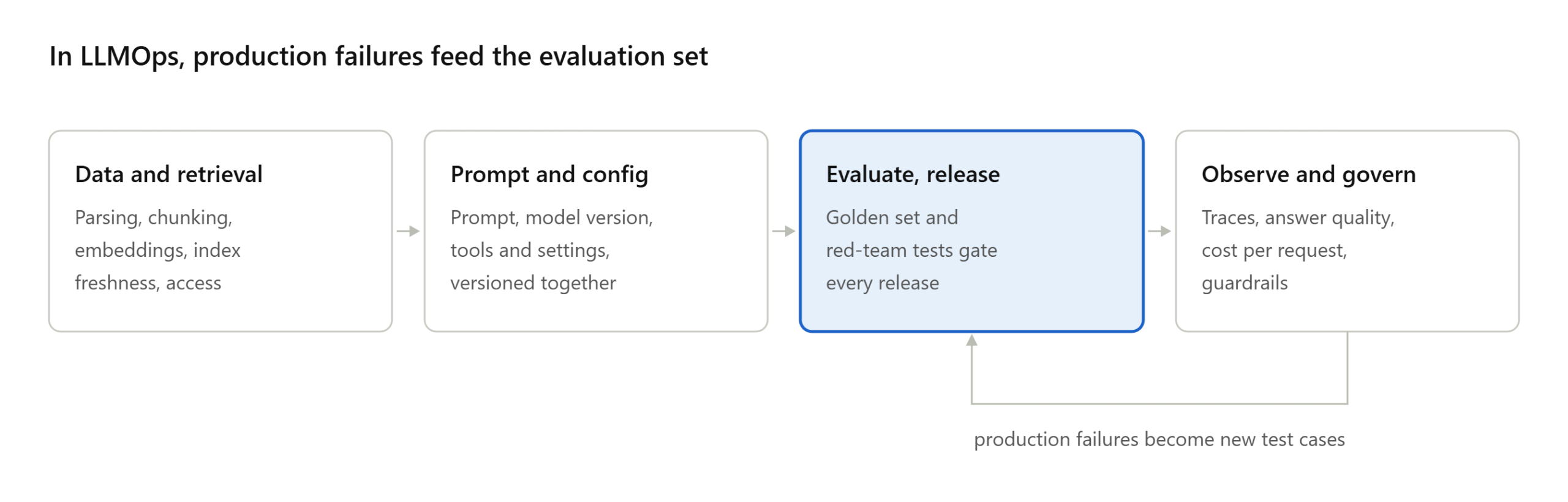
The LLMOps lifecycle runs as a loop. Every failure found in production becomes a new test case, so the evaluation set grows with real usage.
1. You assemble a system instead of training a model
In MLOps, the model is the main artifact. In LLMOps, the model is one setting in a larger configuration. A change to the system prompt, the retrieval filter, the number of passages passed to the model or the tool list can change behavior as much as a new model would.
So version the whole bundle together, give it one release ID, and make it reproducible. If you can’t tell which prompt, model version and index snapshot produced a given answer last Tuesday, you can’t debug it or defend it.
2. Evaluation becomes the release gate
A classifier has a right answer per row. A generated paragraph usually doesn’t, so a single accuracy score stops being useful. LLMOps teams replace it with:
- a golden set of real questions with reference answers and supporting sources;
- graded rubrics for correctness, groundedness, completeness and tone, scored by people or by a judge model that is checked against human ratings;
- regression runs on every change to prompts, models, retrieval or tools;
- red-team cases for jailbreaks, prompt injection and policy violations. This is the same shift we describe in who tests AI generated code: the test set becomes the release gate.
A change ships when it beats the current version on the golden set without new failures in the red-team cases. Our QE-X quality engineering practice runs this kind of validation before AI systems go live.
3. Data work moves into retrieval
In MLOps, data scientists spend their time on features and labels. In LLMOps, most data effort goes into the retrieval layer: parsing PDFs and tables correctly, splitting documents into passages, choosing embedding models, keeping indexes current as documents change, and carrying each document’s permissions into the index. Poor chunking or a stale index produces wrong answers that look confident, and no prompt fixes that. Our Data-to-Insight Factory builds this governed data layer for AI.
4. Monitoring watches behavior as well as drift
Drift still matters, because user questions change over time. LLMOps adds signals that MLOps never needed: whether answers are grounded in the retrieved sources, how often the system refuses or escalates, safety and policy flags, latency to first token, and tokens consumed per request. Tracing matters too. For agents and multi-step chains, you need a trace of every model call, retrieval and tool call, so a bad answer can be followed back to the step that caused it.
5. Cost becomes a per-request variable
Traditional ML puts most of its cost into training. With LLMs, every request costs money, and longer prompts, bigger retrieved contexts and agent loops all add tokens. Cost has to be managed in the platform with model routing (send simple requests to smaller models), caching, context limits and per-team budgets. Cost per successful task is a better unit than cost per call, because a cheap answer that fails costs more once someone has to redo the work.
6. Security gets a new attack surface
The OWASP Top 10 for LLM Applications 2025 lists risks a classic ML security review won’t catch, including prompt injection, sensitive information disclosure, excessive agency, system prompt leakage, vector and embedding weaknesses, and unbounded consumption. The practical response is to enforce permissions at the retrieval layer, scope every tool an agent can call, filter inputs and outputs, and cap tokens and steps per request. Our Responsible AI, Governance and Assurance practice covers these controls through ModelGuard™.
7. Releases depend on someone else’s model
When you train a model, you decide when it changes. With hosted models, the provider can update or retire a version on its own schedule. Pin model versions, run your golden set against a new version before switching, keep a fallback model ready, and track your switching cost. A team that can move to a new model in days has far more negotiating power than one that needs a quarter.
Do you need a separate LLMOps platform?
Usually not. Most enterprises get further by extending the MLOps platform and team they already have than by standing up a parallel one. Choosing where to start is its own exercise, covered in our AI use case prioritisation framework. The additions are specific:
- A model gateway that handles provider access, routing, rate limits, caching and cost tracking.
- A prompt and configuration registry, versioned alongside code.
- A retrieval layer with parsing, embeddings, a vector index and permission sync.
- An evaluation harness with golden sets, judge models and red-team suites wired into CI.
- Tracing and observability for every model call, retrieval and tool call.
- Guardrails for inputs and outputs, plus policy enforcement for agents.
- Clear ownership, so every production use case has a named owner, an evaluation set and a rollback path.
The team shape changes a little as well. Alongside data scientists and ML engineers, you need people who can define what a correct answer looks like for the business and build the test sets that prove it.
How Compunnel Digital helps
Compunnel Digital’s AI Platform and LLMOps Foundation practice is built to take AI from scattered pilots to production on a governed foundation. It works in four stages: InsightForge™ identifies high-value use cases and a 90-day roadmap; the platform architecture covers model hosting, inference APIs and MLOps pipelines; the LLMOps layer operationalizes prompt engineering, fine-tuning, versioning and automated deployment; and integration connects AI systems to ERP, CRM and cloud infrastructure. ModelGuard™ governs model decisions, and AgentWeave™ orchestrates agentic workflows on top. Compunnel reports a 10-week path from kickoff to production-ready agentic AI.
If your MLOps platform is ready for its first production LLM use case, talk to our team about what to add and in what order.
Frequently asked questions
Is LLMOps part of MLOps?
Yes. In the LLMOps vs MLOps comparison, LLMOps is a specialization of MLOps for applications built on large language models. It keeps the MLOps foundation of pipelines, versioning, monitoring and governance, and adds prompt and configuration management, retrieval, evaluation harnesses, guardrails and per-request cost control.
Do we need to fine-tune a model to do LLMOps?
No. Many production systems use a foundation model as it is, combined with retrieval over company data and well-tested prompts. Fine-tuning helps for narrow, repetitive tasks or a specific output format, but it adds training data, evaluation and maintenance work, so it is worth trying retrieval and prompt changes first.
How do you evaluate an LLM application?
Build a golden set of real questions with reference answers and supporting sources, then score outputs on correctness, groundedness and completeness using human reviewers and a judge model calibrated against them. Add red-team cases for prompt injection and policy violations, and rerun the whole set on every change.
What drives LLM costs in production?
Tokens. Every request pays for the prompt, the retrieved context and the generated answer, and agents multiply that across steps. Model routing, caching, tighter retrieval and token budgets are the main levers.
What is the biggest risk when moving from MLOps to LLMOps?
Treating the LLM like a model you can test once. Prompts, retrieved data and provider model versions all change, so quality has to be checked continuously against a test set, with a named owner for each use case.
Conclusion
LLMOps vs MLOps comes down to this: LLMOps keeps the backbone of MLOps and changes what sits on it. You ship a configured system instead of a trained model, you gate releases on evaluation, you put your data effort into retrieval, you watch behavior and cost on every request, and you defend against a new class of attacks. Extending the platform you already have with a gateway, an evaluation harness, tracing and guardrails is usually faster than starting over.
Explore how our Applied AI and agentic systems take enterprise AI from pilot to production.
Sources
- McKinsey & Company, The state of AI, August 2026 (1,719 respondents, surveyed May to June 2026)
- Gartner, Lack of AI-Ready Data Puts AI Projects at Risk, February 2025
- OWASP GenAI Security Project, OWASP Top 10 for LLM Applications 2025
- Compunnel Digital, AI Platform and LLMOps Foundation