Ask an AI assistant about your company’s travel policy and you’ll get a confident paragraph. What it usually won’t tell you is which policy it read.
Was it the version HR published last month? A 2023 PDF sitting in someone’s SharePoint folder? Or nothing at all?
AI enterprise search that cites its sources fixes this. Every statement in the answer links to the passage it came from, so the reader can open the document and check.
People already use AI to find things at work, but they don’t take its answers at face value. According to Microsoft’s 2026 Work Trend Index:
- 15% of the Microsoft 365 Copilot conversations it analyzed were about finding information.
- 86% of the 20,000 knowledge workers it surveyed treat AI output as a starting point they still have to check.
They have good reason to check. In an October 2025 study coordinated by the EBU and led by the BBC, journalists from 22 public service media organizations reviewed more than 3,000 answers from ChatGPT, Copilot, Gemini and Perplexity. A third of the answers had serious sourcing problems.
This article explains how AI enterprise search with citations works step by step, what a good citation looks like, where these systems go wrong, and how to measure one before you roll it out.
Key takeaways
- What it is: retrieval-augmented generation (RAG) over company content, with every sentence of the answer linked to the source passage that supports it.
- How it works: the pipeline has two halves. Indexing (connect, parse, index) runs ahead of time. Answering (retrieve, generate, verify, show) runs for each question.
- Why verification matters: a citation alone is not proof. A public database of court decisions lists 2,095 cases of AI hallucinations in legal filings as of September 2026, and 879 of them cite real sources for points those sources don’t support.
- Permissions: enforce them at retrieval time, before the model sees anything, so an answer can only cite what the user is allowed to open.
- Measurement: track citation precision, citation recall, abstention and permission violations on a test set of real questions before go-live.
What is AI enterprise search that cites its sources?
Cited enterprise search answers a question in plain language from your company’s own content and attaches a citation to each claim. Each citation points to a specific passage in a specific document, one the person asking is allowed to open.
The method underneath is retrieval-augmented generation (RAG): the system retrieves relevant passages first, then has a language model write the answer from them.
It sits between two tools most companies already have:
- Keyword search returns a list of documents and leaves the reading to you.
- A general AI assistant writes a fluent answer from its training data, with no link to your documents.
- Cited search gives you the fluent answer and the evidence together.
| Criteria | Keyword enterprise search | AI assistant without retrieval | Cited enterprise searchRecommended |
|---|---|---|---|
| What you get | A ranked list of documents | A fluent answer | A fluent answer with a source for each claim |
| Where the facts come from | Your documents | The model’s training data | Your documents, retrieved at question time |
| Can you check it? | Yes, by reading the documents | Hard, with no link to evidence | Yes, one click to the supporting passage |
| Respects document permissions | Yes, if the index is security-trimmed | Has no access to company documents | Yes, when trimming happens before generation |
| Reflects last week’s policy change | After re-indexing | No | After re-indexing |
Our Enterprise Knowledge and Document AI practice builds this AI enterprise search layer for enterprises across contracts, SOPs, policies and reports.
Why citations matter more inside a company
A wrong answer from a public chatbot is an annoyance. A wrong answer about a refund limit, a clinical protocol or a contract clause turns into a decision someone acts on. Citations help in two ways:
- They let the reader check before acting.
- They leave a record of which document version supported the answer, which is what auditors and regulators ask for.
A citation is not proof
Retrieval by itself does not make answers reliable. Damien Charlotin’s AI Hallucination Cases database tracks court and tribunal decisions that deal with AI-generated errors in filings. As of September 28, 2026, it listed 2,095 cases.
In 879 of them, a legitimate source had been cited for a point it doesn’t support. That is the misgrounded citation, and it is the error cited enterprise search has to catch before an answer reaches the user.
Public AI search shows the same pattern
In a 2025 study, Columbia Journalism Review’s Tow Center gave eight generative search tools excerpts from news articles and asked them to identify the source. Across 1,600 queries:
- The tools answered incorrectly more than 60% of the time.
- More than half of the responses from Gemini and Grok 3 cited fabricated or broken URLs.
Why a company can do better than the open web
Inside a company, the corpus is known. That makes two checks possible:
- Every citation can be checked against the index before the answer is shown.
- A document the user can’t open can be kept out of the answer entirely.
The pipeline below is built around those two checks.
How AI enterprise search with citations works, step by step
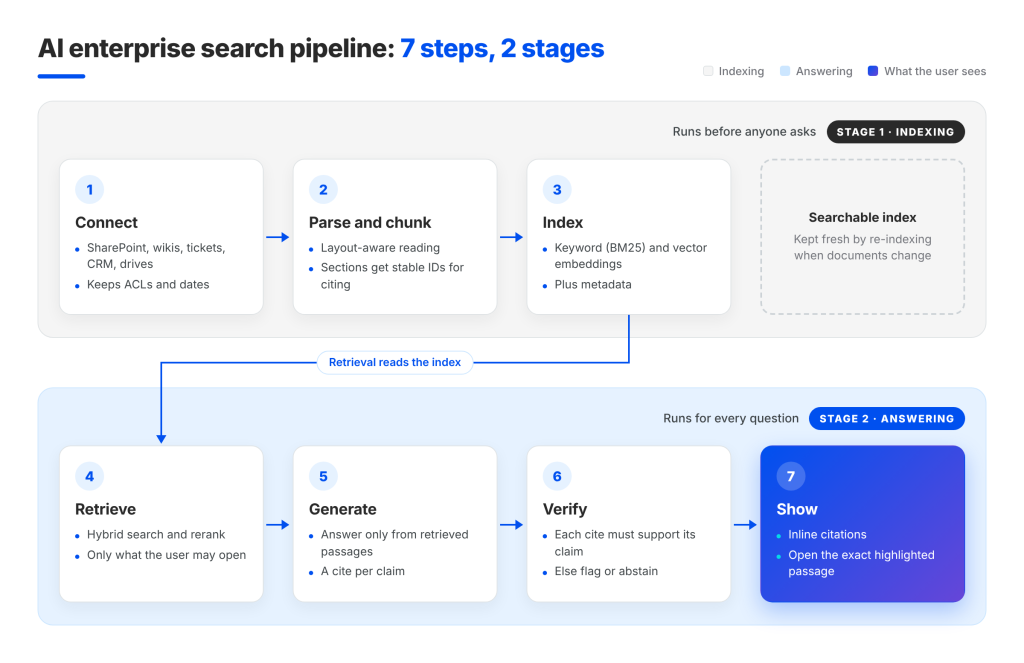
A cited search system runs two processes:
- Indexing (steps 1 to 3) runs ahead of time and keeps up with changes to your content.
- Answering (steps 4 to 7) runs every time someone asks a question.
1. Connect to the sources
Connectors pull content from where people already keep it:
- SharePoint and OneDrive
- Confluence and other wikis
- Google Drive
- Ticketing systems such as ServiceNow or Jira
- CRM records
- File shares
Along with the text, they capture the metadata that later decides what gets cited: owner, last-modified date, version, document type, and the access control list (ACL) that says who may open the file.
2. Parse and chunk
Documents are split into passages small enough to retrieve precisely, usually by section or heading instead of a fixed character count.
- Layout-aware parsing keeps tables, lists and headings intact.
- OCR handles scanned pages.
- Stable passage IDs tie each passage to its document, page and section. That ID is what lets a citation point to one paragraph instead of a 90-page PDF.
This is the work of document intelligence, and it’s what our DocuIntel™ accelerator does for contracts, clinical notes, SOPs, regulatory filings and financial reports.
3. Index for keywords and meaning
Most production systems use hybrid indexing, which combines:
- A keyword index, typically BM25, that catches exact terms such as product codes, policy numbers and names.
- A vector index of embeddings that catches passages saying the same thing in different words.
- Metadata filters for date, department, region or document type.
Some systems also add a knowledge graph that links people, products and documents.
4. Retrieve only what the user may see
When a question comes in, three things happen in order:
- Search: the system may rewrite the question into a clearer search query, then runs both indexes and merges the results.
- Security trimming: results are filtered by the asking user’s identity and group memberships before anything reaches the model.
- Reranking: a reranking model orders the remaining passages by how well they answer the question.
5. Generate a grounded answer
The language model receives the question and the top passages, with two instructions: answer only from those passages, and mark which passage supports each sentence.
If the passages don’t contain the answer, the system should say so. The correct output is a plain statement that the answer wasn’t found in the sources the user can access, along with the closest documents.
6. Verify every citation
A separate check runs after generation. For each citation, it confirms that:
- The cited passage was in the retrieved set.
- The user can open it.
- It actually supports the sentence it’s attached to. This is often judged by a second model prompted or trained to decide whether one text entails another.
Unsupported sentences are removed or flagged. This is the step that targets misgrounded citations, the error behind the 879 misrepresented-source cases in the court database above.
7. Show the answer with its sources
The interface shows numbered citations inline. Clicking one opens the source at the highlighted passage, with the title, section, owner and last-updated date in view.
Feedback such as a thumbs-down or a “wrong source” flag goes to a review queue and into the test set.
Frost & Sullivan Best Practices 2026
Global Company of the Year for Digital CX
11 pages of independent analysis. Free PDF, one short form.
Download the report →What a good citation looks like
A citation is only useful if checking it takes seconds. In a well-built system, each citation:
- Points to a specific passage inside the document.
- Shows the document title, section or page, owner and last-updated date.
- Opens at the highlighted text.
- Links only to content the reader can already open.
When two sources disagree, such as an old and a new version of a policy, the answer should say so and cite both. Blending them into one confident sentence is how outdated rules get repeated.
Where cited search goes wrong, and how to fix it
These are the failures that come up most often, with the usual fix for each.
| Problem | What it looks like | Fix |
|---|---|---|
| Misgrounded citation | A real document is cited for a claim it doesn’t make | An entailment check on every citation; drop or flag unsupported sentences |
| Stale source | The 2023 policy is cited after the 2026 update | Index version and status, rank current documents higher, retire superseded ones |
| Permission leak | An answer quotes a document the user can’t open | Sync ACLs continuously and trim at retrieval, before generation |
| Broken parsing | Table values or scanned pages come out garbled | Layout-aware parsing and OCR, tested on your own documents |
| Over-answering | The model fills gaps from its training data | Answer-only-from-sources instructions and an abstain threshold |
| Weak retrieval | The right passage exists but isn’t found | Hybrid search, reranking and query rewriting, tracked with retrieval recall |
Permission leaks deserve extra care. If filtering happens after the model has written its answer, restricted text may already be in the wording even when the citation is hidden.
How to measure a cited search system
Start with a test set of real questions from each department, each with a reference answer and the passages that support it. Then track these numbers:
- Citation precision: the share of citations that support the sentence they’re attached to. Sourcing was the weakest area in the 2025 EBU and BBC study, where a third of AI answers had serious sourcing problems.
- Citation recall: the share of generated sentences fully supported by their citations.
- Answer correctness: judged against the reference answer.
- Retrieval recall at k: how often the supporting passage appears in the top results.
- Abstention rate: how often the system declines to answer, and how often that was the right call.
- Permission violations: the target is zero.
- Time to answer and citation clicks: how quickly answers arrive, and how often users open the citations.
Rerun the set after every change to models, prompts, chunking or connectors, so accuracy is measured instead of assumed.
Where AI enterprise search with citations pays off
The strongest cases are questions where the answer has to be traceable to an approved document.
- HR and policy: benefits, leave, travel and expense rules, answered from the current policy with the section cited.
- Customer support: agents get an answer along with the knowledge base article behind it.
- Sales and RFPs: security and compliance answers drawn from approved documents that a reviewer can check.
- Legal and contracts: obligations and clauses traced to the exact agreement and page.
- Insurance and financial services: underwriting guidelines, claims procedures and regulatory bulletins cited by version.
- Healthcare and life sciences: SOPs, clinical notes and protocols, where an answer without a source can’t be used.
- Research and technical documents: complex PDFs turned into structured, searchable data with every value traceable to its page.
- IT and engineering: runbooks, incident reviews and architecture decisions.
Questions to ask before you build or buy
- Which sources does it connect to out of the box, and how often does it re-index them?
- Where does permission filtering happen: before the model sees content, or after?
- Does each citation point to a passage, and does it open at that passage?
- Is there a citation verification step, and can we audit what it removed?
- What does it do when the sources don’t contain the answer?
- Where is the index hosted, and is any of our content used to train models?
- Can we run our own test questions and see citation precision and recall?
How Compunnel Digital helps
Compunnel Digital builds cited AI enterprise search through its Enterprise Knowledge and Document AI practice, using four building blocks:
- DocuIntel™ ingests, classifies and extracts content from contracts, SOPs, clinical notes and financial reports.
- SearchCore™ delivers fast, accurate and cited search across an organization’s data sources.
- A knowledge graph layer maps the relationships between documents, entities and concepts.
- ModelGuard™ governs every AI system we deploy.
Compunnel reports 80% to 90% faster search and review in SearchCore™ deployments.
In our AI Document Intelligence engagement, a five-stage AI pipeline replaced manual data extraction from complex scientific PDFs and produced structured, simulation-ready data.
The same retrieval layer powers our AI Workforce and Copilots, where role-based assistants built on SearchCore™ answer from enterprise knowledge inside the tools people already use.
If your teams spend their days hunting through SharePoint folders and wikis, talk to our team about a pilot on one department’s documents.
Want AI answers your teams can check?
Compunnel’s Enterprise Knowledge and Document AI practice builds cited search over your SharePoint, wikis, tickets and policies, with document permissions respected and every answer linked to its source.
Explore Enterprise Knowledge and Document AI →Frequently asked questions
What is retrieval-augmented generation (RAG)?
RAG is a method in which a system first retrieves relevant passages from a document collection and then has a language model write an answer from those passages. AI enterprise search with citations is RAG with passage-level citations, permission filtering and citation checks added.
Do citations stop AI hallucinations?
They make errors visible and easier to catch, but they don’t eliminate them. Of the 2,095 AI hallucination cases in Charlotin’s court database as of September 28, 2026, 879 involve a real source cited for something it doesn’t say. A verification step and the option to abstain reduce the rate, and the citation lets a reader catch what remains.
How does cited search handle document permissions?
It copies each document’s access control list into the index and filters results by the user’s identity at retrieval time. The model only receives passages the user can open, so it has nothing else to quote.
Can it search scanned PDFs, tables and images?
Yes, if the parsing step includes OCR and layout-aware extraction. Answer quality depends heavily on that step, so test it on your own documents, especially tables and forms.
Do we have to move our content into a new repository?
No. Connectors index content where it lives. The index stores extracted text, embeddings and permissions, and each citation links back to the document in its original system.
Conclusion
AI enterprise search that cites its sources works when every step is built for traceability:
- Connectors that keep permissions and dates
- Passages with stable IDs
- Hybrid retrieval that respects access
- Answers limited to what was retrieved
- A check that each citation supports its sentence
The citation is how a reader decides whether to trust an answer, and how an organization shows later where that answer came from.
See how our DocuIntel™ and SearchCore™ accelerators turn document libraries into a searchable, cited knowledge layer.
Sources
- Microsoft WorkLab, 2026 Work Trend Index: Agents, human agency, and the opportunity for every organization, 2026 (20,000 knowledge workers in 10 markets, surveyed February to April 2026)
- EBU and BBC, News Integrity in AI Assistants, October 2025 (22 organizations, 18 countries, more than 3,000 responses)
- Damien Charlotin, AI Hallucination Cases Database, retrieved September 28, 2026
- Jaźwińska and Chandrasekar, Tow Center for Digital Journalism, AI Search Has a Citation Problem, Columbia Journalism Review, March 2025
- Compunnel Digital, Enterprise Knowledge and Document AI and AI Document Intelligence case study