
Cloud governance used to be the thing that slowed delivery down. Two pressures have changed that. Sovereignty requirements now shape where workloads can legally run: Gartner expects sovereign cloud infrastructure spending to reach $80.4 billion in 2026, up 35.6% on 2025, and estimates that 20% of current workloads will move from global to local providers. And AI has introduced a class of system whose behaviour is probabilistic, which makes the question of what it may access a design decision rather than a policy footnote.
This guide sets out what a cloud governance framework contains, the pillars to organize it around, how the policy lifecycle works, the difference between controls that prevent and controls that detect, and a template you can fill in for your own estate.
What this guide covers
Key takeaways
- A cloud governance framework is a set of policies, the controls that enforce them, and the evidence that proves they held. Without the third part it is a document rather than a framework.
- Microsoft’s Cloud Adoption Framework defines governance as a continuous five-step process: build a governance team, assess risks, document policies, enforce policies and monitor compliance. Only the first step happens once.
- The pillars worth organizing around are identity and access, cost, security, data, operations, resource provisioning and AI. These are the domains the major provider frameworks converge on.
- Preventive controls stop a non-compliant resource from existing. Detective controls find it afterwards. A framework that is all detection produces a backlog nobody clears.
- Sovereignty is now a governance driver rather than a compliance edge case, and the growth is regional: Gartner projects 2026 sovereign cloud spending growth of 89% in the Middle East and Africa, 87% in mature Asia Pacific and 83% in Europe.
What a cloud governance framework is
A cloud governance framework answers four questions in a form a machine can act on. What is allowed. Who decides exceptions. How the rule is enforced. How you prove it was enforced.
Most governance documents answer the first and stop. The result is a policy library that reads well and describes an estate nobody recognizes, because the rules were never wired to anything that could apply them. The useful version pairs every policy with a mechanism and an evidence source, which is why the template later in this guide has columns for both.
Governance is also not the same as security. Security is one pillar inside it. Governance covers cost, data placement, provisioning standards and now AI usage alongside security, and its job is to make the organization’s choices consistent rather than to defend against an attacker.
The pillars
Microsoft’s Cloud Adoption Framework names its governance domains as security, regulatory compliance, operations, cost management, data management, resource provisioning and emerging areas such as AI. AWS organizes the same ground across its Well-Architected pillars with cost optimization as a named pillar of its own, and sets guardrails through account structure and service control policies. The vocabularies differ and the content converges.
Seven pillars cover what an enterprise estate needs.
- Identity and access: who can do what, in which account or subscription, with which privileges, and how access is reviewed and removed.
- Cost: allocation and tagging standards, budget ownership, commitment authority, and who may provision expensive resource classes.
- Security: encryption requirements, network exposure rules, vulnerability and patch standards, secrets handling.
- Data: classification, residency and sovereignty, retention, backup and deletion.
- Operations: observability requirements, SLOs, change management, incident process and on-call ownership.
- Resource provisioning: approved regions, approved services, naming conventions, infrastructure-as-code requirements and landing zone standards.
- AI: which models may be used, what data may reach them, what must be logged, and which decisions require a human.
The AI pillar is the newest and the one most frameworks are still retrofitting. Flexera’s 2026 State of the Cloud report found 53% of organizations naming security and compliance as their top challenge for cloud-based AI initiatives, ahead of data quality at 40%, which suggests the governance question is arriving before the technical one is settled.
The governance lifecycle
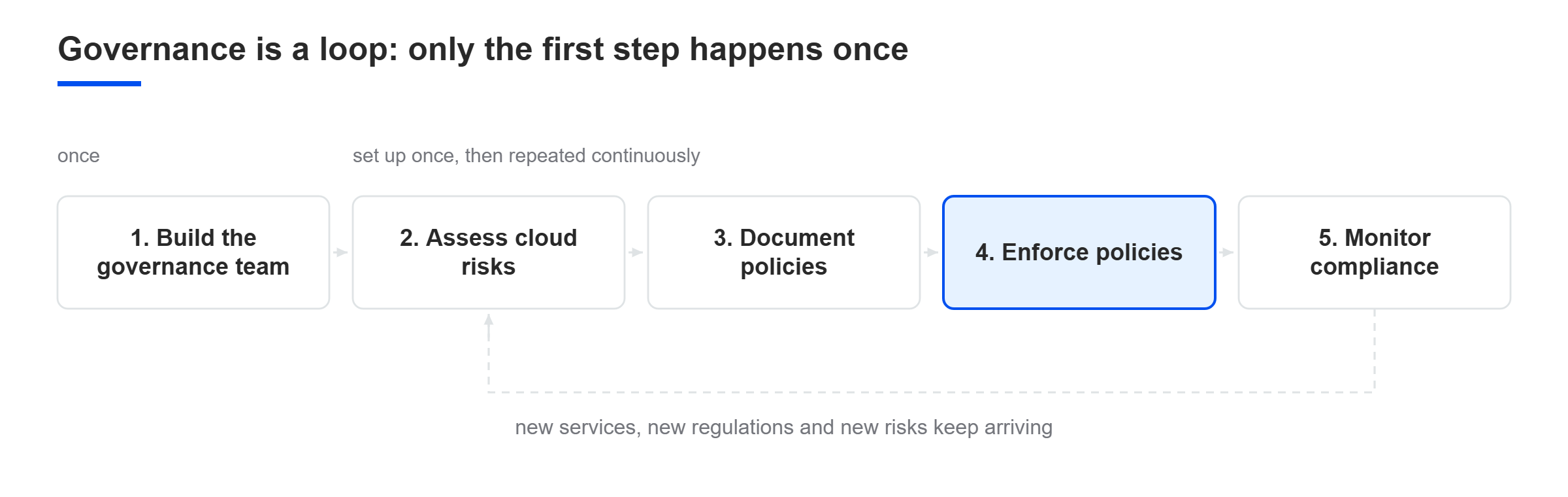
Microsoft’s Govern methodology is explicit that only the first step is one-off. Building the governance team establishes ownership and accountability once. Assessing risks, documenting policies, enforcing them and monitoring compliance are set up once and then repeated continuously, because new services, new regulations and new risks keep arriving.
The step organizations skip is the second. Writing policies without assessing risk first produces a framework copied from a template, which then either blocks work nobody needed blocked or permits the thing that actually hurts. Risk assessment is what makes a policy library specific to your estate.
The step organizations underinvest in is the fifth. Microsoft suggests monitoring compliance through metrics such as compliance levels, policy violations, incident response times and user satisfaction. That last one is not decoration. A framework with high compliance and miserable engineers is being worked around somewhere you cannot see.
Preventive and detective controls
Every control is one of two kinds, and the mix decides whether governance is real.
A preventive control stops the non-compliant thing from existing. A service control policy that denies resource creation outside approved regions, a policy that refuses to deploy a storage account without encryption, a pipeline gate that fails a plan with a public security group. Nothing to remediate, because nothing was created.
A detective control finds the non-compliant thing after the fact. Configuration rules that flag unencrypted volumes, a report of untagged resources, a scan for over-permissive roles. These are necessary, because not everything can be prevented without blocking legitimate work, and they generate a queue.
The failure pattern is a framework that is nearly all detective. Findings accumulate faster than anyone remediates them, the dashboard turns permanently amber, and the organization learns to ignore it. The fix is to promote the highest-volume recurring findings into preventive controls, so the same violation stops being possible rather than being re-reported monthly.
Policy as code
Policies written in a document are interpreted. Policies written as code are applied. Modern governance expresses rules in a form the platform evaluates automatically: service control policies and configuration rules on AWS, Azure Policy definitions and initiatives, organization policy constraints on Google Cloud, and Open Policy Agent for rules that need to span providers or run inside a pipeline.
Three practices make it work. Evaluate at plan time, so an infrastructure-as-code change is rejected before it is applied rather than flagged after. Version the policies in the same repository discipline as the infrastructure, with review and a changelog. And write an exception process with an owner and an expiry date, because a governance framework with no route to an exception gets bypassed rather than followed.
The pressures reshaping governance in 2026
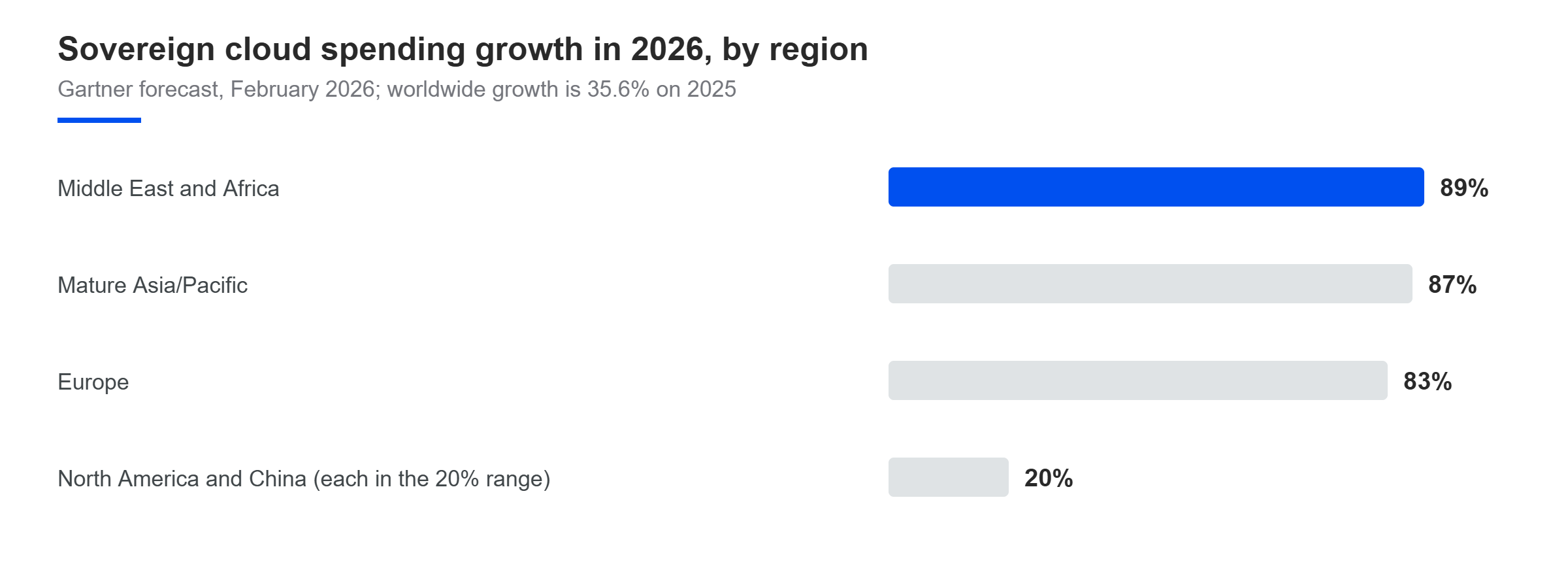
Sovereignty is the pressure with the clearest numbers behind it. Gartner’s February 2026 forecast puts sovereign cloud infrastructure spending at $59.3 billion in 2025, $80.4 billion in 2026 and $110.6 billion in 2027, with Europe expected to overtake North America in 2027. The firm names geopolitical tension, the desire for technological independence and keeping economic value within national borders as drivers, with governments the main buyers followed by regulated industries and critical infrastructure.
For a governance framework, that translates into a data pillar that has to carry real residency rules per data class, a provisioning pillar with an approved-region list that changes, and an architecture that can place a workload by jurisdiction rather than by convenience. Gartner’s Rene Buest makes the point that treating digital sovereignty purely as a security and compliance topic is not enough, which is a fair description of how most frameworks currently handle it.
AI is the other pressure, and it reaches every pillar at once. Identity has to cover what an agent may do on a user’s behalf. Data has to cover what may be sent to a model and what the model’s outputs may be used for. Operations has to cover logging and human review. Cost has to cover consumption that scales with application behaviour rather than provisioned capacity.
A governance policy template
Use one row per policy. The value is in the last two columns, because they are what turn a statement into something that holds.
| Pillar | Example policy statement | Control type and enforcement | Evidence for audit |
|---|---|---|---|
| Identity and access | No standing administrative access in production; privileged access is time-bound and approved | Preventive, through just-in-time elevation and a deny policy on permanent admin role assignment | Elevation request log with approver and duration |
| Cost | Every resource carries owner, environment, product and cost centre tags at creation | Preventive, through policy that denies creation of untagged resources, plus a detective report on drift | Monthly allocation coverage percentage |
| Security | Data at rest is encrypted with customer-managed keys in production | Preventive, through policy refusing unencrypted resource creation | Configuration compliance report per account |
| Data | Personal data for EU subjects is stored and processed only in approved EU regions | Preventive, through an approved-region constraint, with a detective rule on data movement | Region constraint policy state plus data transfer logs |
| Operations | Every production service has an SLO, an owner and an on-call rotation before go-live | Preventive, through a release checklist gate in the pipeline | Service catalogue entry with SLO and rotation |
| Resource provisioning | Production infrastructure is created only through infrastructure-as-code pipelines | Detective on console changes, preventive through restricted write permissions | Drift detection report and change audit trail |
| AI | Only approved models may process internal data; prompts and responses are logged with retention limits | Preventive, through an approved-model gateway, with a detective check on direct provider calls | Gateway request logs and periodic egress review |
Start with one row per pillar rather than a complete library. Seven enforced policies beat seventy aspirational ones, and the practice of writing the enforcement and evidence columns exposes which policies you cannot actually apply yet.
Common failure modes
Four patterns account for most governance frameworks that do not work.
The framework is a document. Policies exist, nothing evaluates them, and compliance is self-reported by the teams being governed.
Everything is detective. The findings queue grows faster than remediation and the organization habituates to a permanently non-compliant dashboard.
There is no exception path. Engineers route around the control instead of requesting a documented, expiring exception, and the framework loses visibility of exactly the cases it most needed to see.
Governance is set up at the landing zone and never revisited. New services arrive, the approved-service list goes stale, and teams either wait for approval that has no owner or proceed without it.
How Compunnel Digital helps
Compunnel Digital puts governance into the platform at the point where it is cheapest to enforce.
- Cloud-native accelerators: SecureLanding™ provides pre-built secure landing zone templates for AWS, Azure and GCP with multi-account architecture, network topology, RBAC and compliance controls, so security and governance are established before the first resource is deployed. ShieldCI™ embeds security checks into CI/CD pipelines, covering static and dynamic testing, container scanning, compliance validation and secrets management on every code push. FinOpsVision™ covers the cost pillar with automated tagging enforcement and FinOps governance dashboards.
- Applied AI and Agentic Systems addresses the AI pillar through Responsible AI, Governance and Assurance, with ModelGuard™ as the governance layer that ships with every Compunnel AI engagement.
- Cloud migration and modernization applies the provisioning and placement standards during migration, when the account structure, network topology and region decisions are being made.
- Managed SRE and AIOps supplies the operations pillar: SLOs, SLIs, error budgets and reliability governance, with the observability architecture that evidences them.
If your governance framework is a document rather than a set of enforced controls, talk to our team about a cloud governance assessment.
Frequently asked questions
What is a cloud governance framework?
A cloud governance framework is the combination of policies that define what is allowed in your cloud estate, the controls that enforce those policies, the exception process for legitimate deviations, and the evidence that demonstrates compliance. A framework without enforcement mechanisms and evidence sources is a policy document rather than a framework.
What are the pillars of cloud governance?
Identity and access, cost, security, data, operations, resource provisioning and AI. Microsoft’s Cloud Adoption Framework names security, regulatory compliance, operations, cost management, data management, resource provisioning and emerging areas such as AI as its governance domains, and AWS covers similar ground through its Well-Architected pillars and account-level guardrails.
What is the difference between preventive and detective controls?
A preventive control stops a non-compliant resource from being created, such as a policy that denies resource creation outside approved regions. A detective control identifies non-compliance after the fact, such as a rule that flags unencrypted storage. Frameworks need both, and ones that rely mostly on detection accumulate findings faster than teams remediate them.
What is policy as code?
Policy as code expresses governance rules in a machine-evaluated form rather than prose, using tools such as AWS service control policies and config rules, Azure Policy, Google Cloud organization policy constraints or Open Policy Agent. Evaluating those policies at plan time means a non-compliant infrastructure change is rejected before it is applied.
How does cloud governance relate to FinOps?
Cost is one governance pillar, and FinOps is the operating model that runs it. The FinOps Framework includes governance, policy and risk as a named capability, and the tagging and allocation standards a FinOps practice depends on are enforced through governance controls at provisioning time. Compunnel Digital runs this as a managed FinOps and GreenOps service.
Conclusion
A cloud governance framework earns its keep when every policy has a mechanism and an evidence source behind it. Organize the policies into seven pillars, run the lifecycle as a loop rather than a project, promote your highest-volume detective findings into preventive controls, express the rules as code evaluated before deployment, and give exceptions an owner and an expiry date. The two pressures that will test the framework over the next two years are sovereignty, where the spending data shows how fast the ground is moving, and AI, which touches all seven pillars at once.
Explore how our Cloud, Platforms and Engineering practice builds governed cloud platforms from the landing zone up.
Sources
- Gartner, Worldwide sovereign cloud IaaS spending will total $80 billion in 2026, 9 February 2026
- Microsoft Learn, Cloud Adoption Framework: Govern methodology
- AWS, Well-Architected Framework: Cost Optimization Pillar and Governing infrastructure as code using pattern-based policy as code
- Flexera, 2026 State of the Cloud Report, March 2026 (53% name security and compliance as the top cloud AI challenge)
- FinOps Foundation, FinOps Framework (governance, policy and risk as a named capability)
- FinOps Foundation, State of FinOps 2026 survey findings, 19 February 2026 (governance and forecasting now outrank optimization alone)