
The average breach now costs $4.99 million globally, a 12% rise and a record, according to IBM’s Cost of a Data Breach Report 2026. The average time to identify and contain one has gone back up to 247 days, reversing several years of gradual improvement. For organizations running hybrid estates, the detail that matters most is where those 247 days get spent: crossing the seams between environments, where ownership is ambiguous and tooling does not follow the traffic.
This guide covers the risks specific to hybrid cloud, why the seams rather than the environments are the problem, the controls that actually close them, and the practices that shorten the time from first signal to containment.
Key takeaways
- Hybrid security problems concentrate at the seams: identity federation, network interconnect, data replication, secrets and key management, and the delivery pipeline that deploys to both sides.
- Identity is the real perimeter. Where a hybrid estate maintains two directories, access reviews become unreliable and privileged access accumulates in the gap between them.
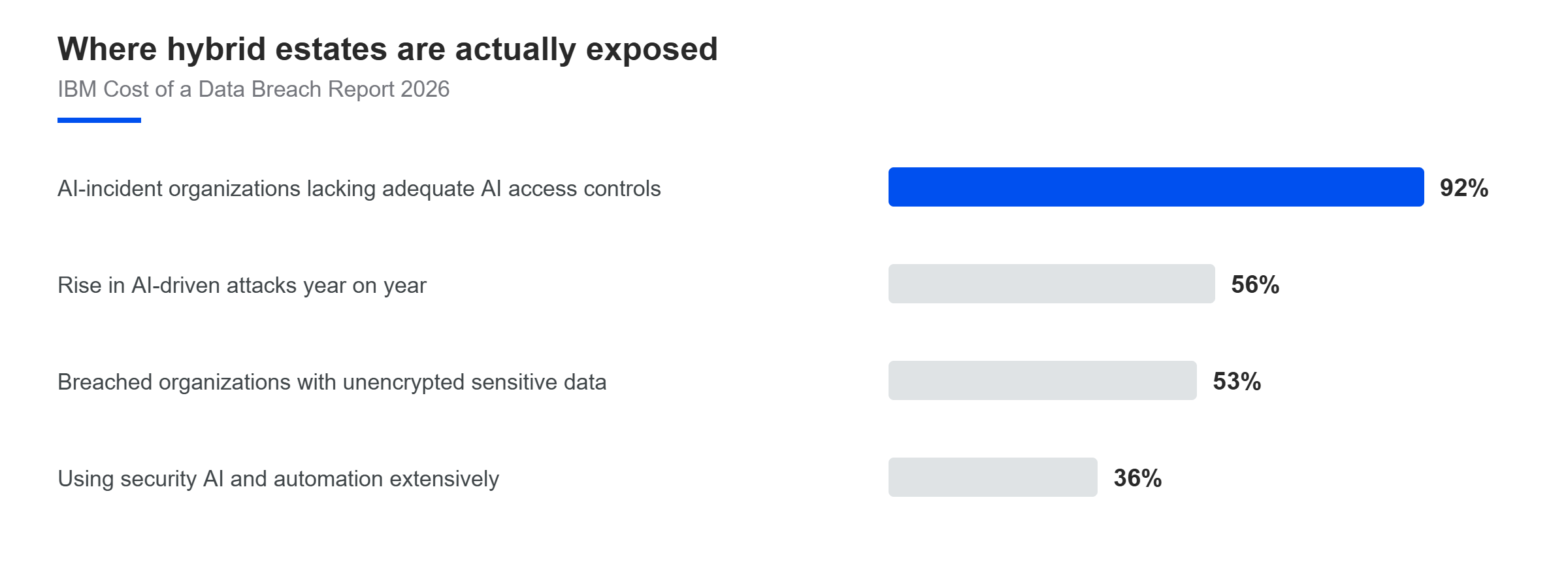
- AI has created a fast-growing exposure. IBM found AI-driven attacks rose 56% year on year, and that 92% of organizations suffering an AI-related incident lacked adequate AI access controls.
- Encryption discipline remains weak. In the same study, 53% of breached organizations said sensitive data was not encrypted at rest or in transit.
- Security automation pays measurably. Organizations using security AI and automation extensively saved $1.93 million per breach and shortened breach lifecycles by 65 days, and only 36% used these capabilities extensively.
Why hybrid is harder than either environment alone
A public cloud estate has one identity model, one policy engine, one audit log and one set of defaults. A private estate has its own. A hybrid estate has both, plus the connections between them, and the connections are where controls get written last.
Three structural reasons explain it. Tooling rarely spans the boundary cleanly, so a cloud security posture tool sees cloud resources and an on-premises scanner sees servers, and neither sees the path between them. Ownership divides by location rather than by service, so a cross-boundary incident starts with a handoff. And trust is often implicit across the interconnect: traffic arriving over a dedicated link is frequently treated as internal, which means a foothold on one side inherits reach on the other.
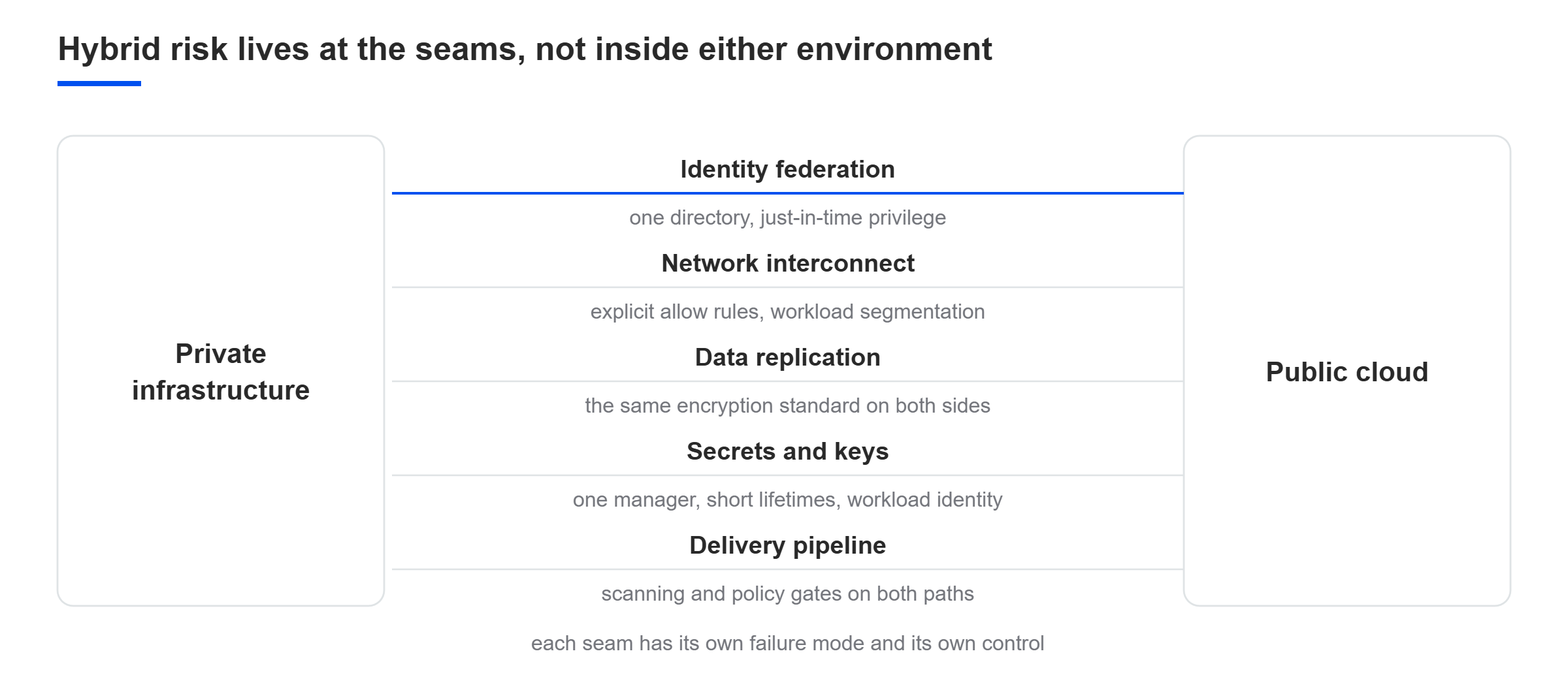
The five seams above are where to concentrate effort. Each one has a specific failure mode and a specific control, and they are more productive to work on than another scanner pointed at resources you already monitor.
The risks worth naming
Identity sprawl across two directories. Duplicate accounts, inconsistent group membership, service accounts created on one side for a system on the other. The practical consequence is that nobody can answer who has administrative access to a given production system without assembling the answer by hand.
Implicit trust over the interconnect. A dedicated link is a network path, not a trust boundary. Where firewall rules between locations are permissive because both ends are “internal,” an attacker who lands on a neglected on-premises host reaches cloud workloads without crossing a control.
Inconsistent data protection. Encryption and key management defaults differ between environments. Data classified as sensitive in one place is often replicated to the other under weaker controls, which is how the 53% figure for unencrypted sensitive data happens in organizations that believe they encrypt everything.
Secrets in transit between environments. Pipelines that deploy to both sides need credentials for both sides. Those credentials end up in CI variables, configuration files and occasionally repositories, and they are long-lived because rotating them breaks something nobody wants to debug.
Divergent patching and configuration standards. Cloud resources get rebuilt from images regularly; on-premises servers get patched in place on a slower cycle. The gap is where known vulnerabilities persist.
AI access controls that were never designed. Models and agents reach data across both environments, often through credentials with broader permissions than any human would be granted. IBM’s finding that 92% of organizations with an AI-related incident lacked adequate AI access controls describes a control that largely does not exist yet in most estates.
The controls that close the seams
One identity plane. A single authoritative directory, federated to both environments, with conditional access applied consistently and privileged access granted just in time rather than standing. This is the highest-leverage change available in most hybrid estates and also the slowest, which is why it should start first.
Segmentation that does not stop at the boundary. Treat the interconnect as untrusted. Workload-level segmentation, mutual TLS between services, and explicit allow rules for cross-boundary flows rather than a permissive rule between address ranges.
Centralized secrets with short lifetimes. One secrets manager reachable from both sides, workload identity rather than static credentials wherever the platform supports it, and automated rotation. A secret that cannot be rotated without an outage is an incident waiting for a trigger.
Consistent encryption and key custody. Decide per data class where keys live and who can use them, and apply the same standard on both sides. Where sovereignty requires it, keep key custody in the jurisdiction, which is a governance decision with an architectural consequence.
Unified detection. Logs from both environments in one place, with detections written for cross-boundary behaviour specifically: a cloud role assumed from an on-premises host, replication traffic to an unexpected destination, a service account authenticating from a new location. IBM found internal teams identified and contained breaches roughly 15% faster than external providers, which argues for keeping the detection capability close to the people who know the estate.
A single pipeline with gates on both paths. The delivery pipeline is the most common route to production in both environments, so the controls belong there: static and dynamic testing, container and image scanning, policy evaluation at plan time, and secrets detection on every push.
The AI exposure specifically
AI systems break the assumptions hybrid security was built on. A model or agent typically needs read access across data that was deliberately partitioned, it reaches that data through a service identity rather than a user session, and the access pattern is generated by the application rather than chosen by a person.
Four controls address most of it. Scope the identity: an agent gets its own identity with narrowly scoped, runtime-enforced permissions rather than a shared service account. Keep human attribution: record which user’s request an agent acted on, so an action has an accountable origin. Gate the models: route model calls through an approved gateway so there is one place to apply policy and one log to read. And log prompts and responses with a retention policy, because an AI incident cannot be investigated without them.
IBM’s own guidance in the 2026 report points the same way, recommending dynamic identity-based access controls, tightly scoped permissions enforced at runtime, human attribution and auditability for AI agents. The cost data behind it is specific: AI model inversion attacks averaged about $6.07 million and prompt injection attacks about $5.89 million.
Best practices
- Unify identity before buying anything. One directory, federated, with just-in-time privileged access. Most other controls depend on it and get weaker without it.
- Treat the interconnect as hostile. Explicit allow rules for cross-boundary flows, workload-level segmentation, and no rule that trusts an address range because it is on your own network.
- Put detection in one place and write cross-boundary rules. The seams need their own detections, not the union of two environments’ default rules.
- Encrypt by data class, consistently, and decide key custody deliberately. Replication is the step where standards usually slip.
- Give AI systems their own scoped identities and route model access through a gateway. This is the control most estates are missing entirely.
- Rehearse a cross-boundary incident. Pick a scenario that starts on one side and spreads to the other, and run it. The handoff is the thing you are testing.
- Invest in automation where the evidence supports it. The $1.93 million saving and 65-day reduction IBM associates with extensive use of security AI and automation is among the better-supported numbers in security economics, and only 36% of organizations have taken it.
How Compunnel Digital helps
Compunnel Digital builds the controls into the platform and the pipeline rather than layering them on afterwards.
- Cloud-native accelerators: ShieldCI™ embeds security into CI/CD with static and dynamic testing, container scanning, compliance validation and secrets management applied to every code push. SecureLanding™ provides secure landing zone templates for AWS, Azure and GCP with multi-account architecture, network topology, RBAC and compliance controls, so the identity and segmentation model exists before the first workload lands.
- Applied AI and Agentic Systems covers the AI exposure through Responsible AI, Governance and Assurance, with ModelGuard™ as the governance layer that ships with every Compunnel AI engagement, and the AI Platform and LLMOps foundation where model access is actually mediated.
- Managed SRE and AIOps supplies the observability architecture spanning environments, with metrics, logs and traces in one place and ML-assisted correlation, which is the substrate unified detection runs on.
- Cloud migration and modernization is where the account structure, network topology and identity design get set, and therefore where most of the hybrid security posture is decided.
If your hybrid estate has controls on both sides and nothing watching the path between them, talk to our team about a hybrid security assessment.
Frequently asked questions
What are the biggest hybrid cloud security risks?
Identity sprawl across two directories, implicit trust over the interconnect between environments, inconsistent data encryption and key management, long-lived secrets shared by pipelines that deploy to both sides, divergent patching standards, and AI systems operating with permissions nobody scoped. The common factor is that each risk lives at a seam rather than inside one environment.
Why is hybrid cloud harder to secure than public cloud alone?
Because the tooling, the ownership and the trust model all stop at the boundary. Cloud posture tools see cloud resources, on-premises tooling sees servers, and the path between them is often treated as internal and therefore trusted. Ownership divided by location also means cross-boundary incidents begin with a handoff instead of an investigation.
How does zero trust apply to hybrid cloud?
By removing the assumption that network location implies trust. In practice that means authenticating and authorizing every request regardless of origin, segmenting at the workload level rather than by address range, using short-lived workload identities instead of static credentials, and applying the same conditional access policy to requests arriving over a dedicated interconnect as to requests from the internet.
What does a data breach cost in 2026?
IBM’s Cost of a Data Breach Report 2026 puts the global average at $4.99 million, up 12% and a record high, with the United States average at $11.5 million. Average time to identify and contain a breach rose to 247 days, and breaches lasting beyond 200 days averaged $5.65 million against $4.32 million for faster-resolved incidents.
How do we secure AI systems across a hybrid estate?
Give each model or agent its own identity with narrowly scoped permissions enforced at runtime, keep human attribution so every action traces to a requesting user, route model access through an approved gateway that applies policy and produces one audit log, and log prompts and responses under a defined retention policy. IBM found 92% of organizations with AI-related incidents lacked adequate AI access controls.
Conclusion
Hybrid cloud security is mostly about the seams, and there are five of them: identity federation, network interconnect, data replication, secrets and keys, and the delivery pipeline. Unify identity first, treat the interconnect as untrusted, put detection in one place with rules written for cross-boundary behaviour, make encryption and key custody consistent by data class, and give AI systems scoped identities routed through a gateway. The 2026 cost data makes the case for urgency, and the same study shows that automation applied seriously takes two months off a breach lifecycle.
Explore how our Cloud, Platforms and Engineering practice builds secure landing zones, pipeline controls and cross-environment observability.
Sources
- IBM and Ponemon Institute, Cost of a Data Breach Report 2026 (global average $4.99M, up 12%; AI-driven attacks up 56%; AI model inversion averaging $6M; $1.93M saving from extensive security AI and automation)
- eSecurity Planet, IBM 2026 Cost of a Data Breach Report key findings (US average $11.5M; 247 days to identify and contain; 92% of AI-incident organizations lacked adequate AI access controls; 53% with unencrypted sensitive data; 36% using security AI extensively)
- Flexera, 2026 State of the Cloud Report, March 2026 (73% hybrid; 53% name security and compliance the top cloud AI challenge)
- Cloudera and Wakefield Research, The Great AI Re-Architecture, fielded June 2026, reported by Virtualization Review (1,500 respondents; vendor-commissioned)
- Microsoft Learn, Cloud Adoption Framework: Govern methodology
- AWS, Governing infrastructure as code using pattern-based policy as code
- Google Cloud, Google Distributed Cloud (air-gapped option for isolated and sovereign requirements)