
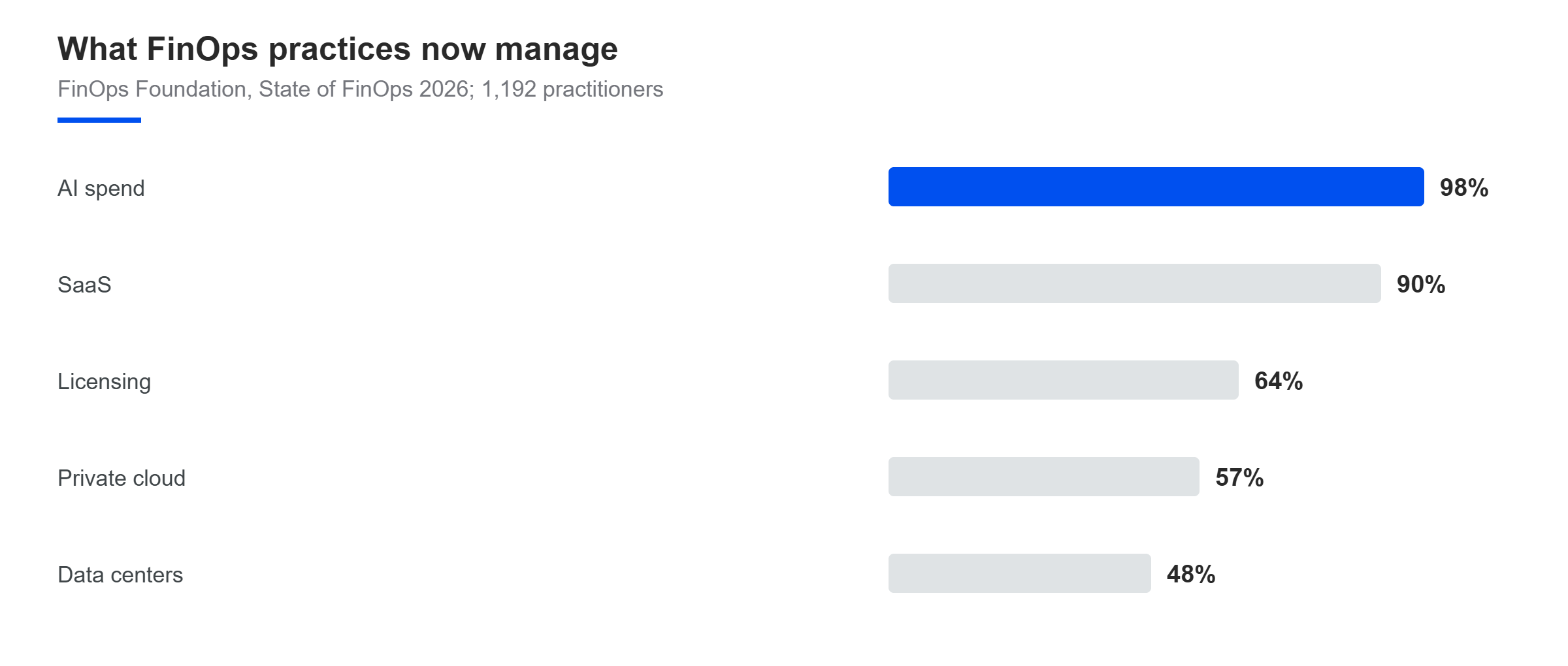
FinOps stopped being about cloud bills. In the FinOps Foundation’s State of FinOps 2026 survey, covering 1,192 practitioners at organizations representing more than $83 billion in annual cloud spend, 98% said they now manage AI spend, up from 31% two years earlier. Ninety percent manage SaaS, 64% manage licensing, 57% manage private cloud and 48% manage data centers. The discipline that started as cloud cost management now covers most of what an organization spends on technology.
This guide explains what FinOps is, walks through the framework as the FinOps Foundation defines it, covers the three phases and four domains, and sets out the practices that distinguish a working practice from a reporting function.
Key takeaways
- FinOps is an operating model for making technology spending decisions, not a cost-cutting program. The FinOps Foundation defines it through six principles, three phases, four domains and a set of capabilities under each domain.
- The three phases are Inform, Optimize and Operate, and they run as a continuous loop rather than a sequence you finish.
- Scope has expanded well past public cloud. The framework now organizes spend into Technology Categories covering AI, public cloud, SaaS, data platforms, private cloud, licenses and data centers.
- FOCUS, the FinOps Open Cost and Usage Specification, is the data standard that makes multi-provider reporting possible. Version 1.4 was ratified on 4 June 2026, and about 68% of organizations spending over $100 million already use or experiment with FOCUS-formatted data.
- The priorities have shifted. Governance, forecasting and organizational alignment now rank above optimization and efficiency alone, and shift-left guidance before deployment is the most requested tooling capability.
What FinOps actually is
FinOps is the practice of bringing financial accountability to variable technology spending, so that engineering, finance, product and leadership make trade-offs with the same numbers in front of them. The emphasis belongs on decisions rather than reductions. A FinOps practice that cuts spend while slowing delivery has failed at its job, and one that approves a spending increase because the unit economics justify it has done it well.
The FinOps Foundation, part of the Linux Foundation, maintains the framework that most organizations now use. It is explicitly described as flexible and non-prescriptive, meaning you adopt the components that fit and grow the practice over time rather than implementing all of it at once.
The six principles
The framework rests on six principles, and they are worth stating plainly because most disagreements inside a FinOps practice trace back to one of them being ignored.
- Teams need to collaborate.
- Business value drives technology decisions.
- Everyone takes ownership for their technology usage.
- FinOps data should be accessible, timely and accurate.
- FinOps should be enabled centrally.
- Take advantage of the variable cost model of the cloud.
The third and fifth do most of the work in practice. Central enablement with distributed ownership is the model that holds, and the State of FinOps data supports it: 60% of practices use centralized enablement with embedded champions, 21% use a hub-and-spoke structure, and under 10% are fully decentralized.
The three phases
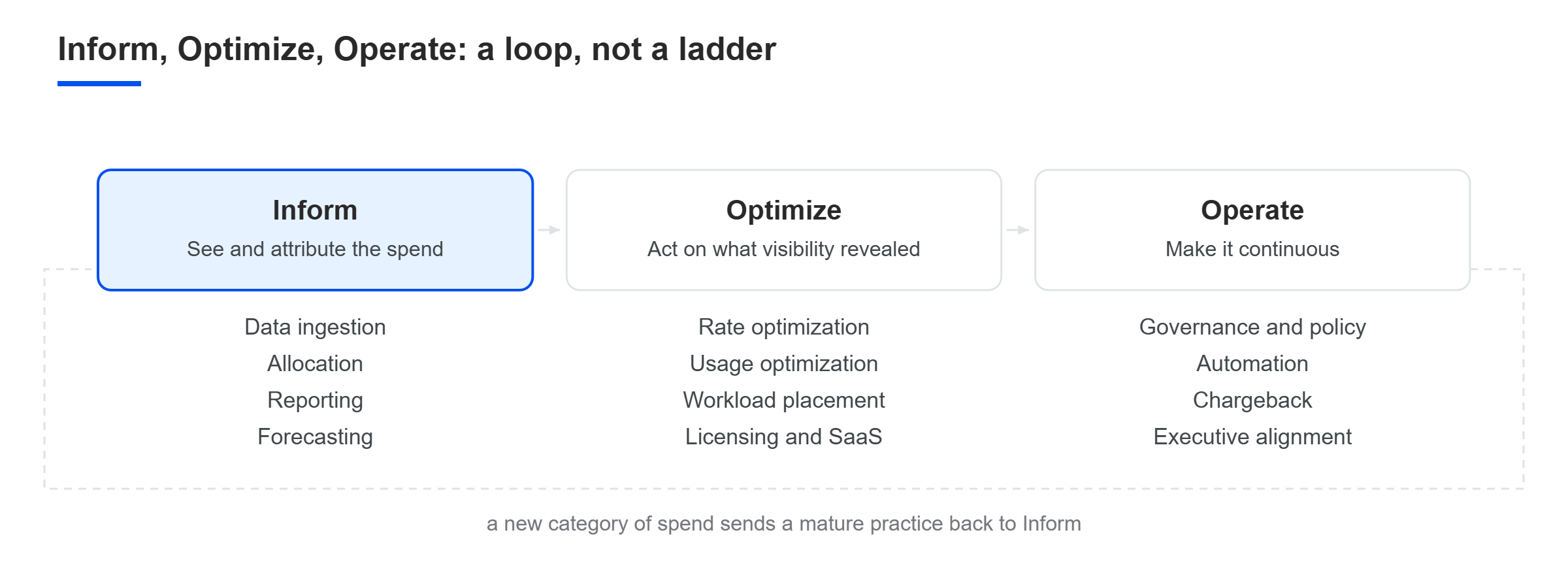
Inform is about visibility and allocation. You cannot make a decision about a cost you cannot see or attribute. This phase covers data ingestion, allocation, reporting and analytics, forecasting and budgeting. Most organizations spend longer here than they expect, because allocation in a shared estate is genuinely hard.
Optimize is about acting on what the first phase revealed. Rate optimization through commitments and licensing, usage optimization through rightsizing and scheduling, workload placement and architectural decisions all sit here.
Operate is about making it continuous. Policies, governance, automation, chargeback and the organizational alignment that keeps the practice running when the person who started it moves on.
The phases are a loop, not a ladder. A new Technology Category entering scope, AI being the obvious current example, puts a mature practice straight back into Inform for that category while it continues to Operate for the rest.
The four domains and their capabilities
The framework groups capabilities into four domains. This table is the most useful single reference in the framework, because it names the specific things a practice can be good or bad at.
| Domain | Capabilities |
|---|---|
| Understand Usage and Cost | Data Ingestion, Allocation, Reporting and Analytics, Anomaly Management |
| Quantify Business Value | Planning and Estimating, Forecasting, Budgeting, KPIs and Benchmarking, Unit Economics |
| Optimize Usage and Cost | Architecting and Workload Placement, Usage Optimization, Rate Optimization, Licensing and SaaS, Sustainability |
| Manage the FinOps Practice | Executive Strategy Alignment, FinOps Practice Operations, Governance Policy and Risk, Education and Enablement, Invoicing and Chargeback, FinOps Assessment, Automation, Tools and Services, Intersecting Disciplines |
Reading that fourth domain tells you where most practices are weakest. Executive strategy alignment and governance are management capabilities, and they are the ones a team of engineers running a cost dashboard tends to skip. The State of FinOps 2026 finding that 78% of FinOps teams now report to the CTO or CIO, up 18 points, suggests organizations are correcting for that.
Who is involved
The framework names core personas (FinOps practitioner, engineering, finance, leadership, procurement, product) and allied personas (IT asset management, IT financial management, IT service management, security, sustainability). The practical test of a practice is whether engineering and finance meet regularly with the same data. Where they do not, FinOps becomes a reporting function that produces numbers nobody acts on.
Executive engagement changes outcomes measurably. In the 2026 survey, practices with VP-level or C-suite engagement reported far greater influence over decisions: 53% versus 24% on cloud service selection, 47% versus 16% on provider selection, and 28% versus 12% on whether a workload lands in cloud or a data center.
What FinOps covers in 2026
The scope expansion is the biggest change in the discipline. The framework now organizes spending into Scopes, defined segments of spend aligned to business constructs such as products, cost centres or environments, across Technology Categories that include AI, public cloud, SaaS, data platforms, private cloud, licenses and data centers. The Foundation published framework updates in March 2026 covering executive strategy alignment and refining Scopes, followed in April 2026 by guidance on bringing the data center into modern FinOps.
AI is the category reshaping the practice. FinOps for AI is the top forward-looking priority in the 2026 survey, and AI value management is the most sought-after new skill. The difficulty is that AI spend resists the techniques that work on infrastructure: there is no reserved instance for a token, consumption is driven by application behaviour rather than provisioned capacity, and the value of an inference is harder to quantify than the value of a virtual machine.
FOCUS: the data standard underneath
Comparing spend across providers used to mean reconciling incompatible billing exports. FOCUS, the FinOps Open Cost and Usage Specification, is the open standard that fixes it by defining a common schema for cost and usage data.
Version 1.4 was ratified by the FOCUS Steering Committee on 4 June 2026. It added Invoice Detail and Billing Period datasets for reconciling usage against issued invoices, expanded the Contract Commitment dataset from 13 to 30 columns, added a Commitment Program Eligibility Details column showing charges that qualify for a commitment program whether or not one is applied, and defined cost recognition rules so that effective cost and billed cost sum to the same total. It shipped with no incompatible changes, which matters for anyone already building on 1.3.
Adoption is concentrated at the top end: around 68% of organizations spending more than $100 million a year use or experiment with FOCUS-formatted data, with a further 18% planning to. If you are specifying tooling now, asking vendors for FOCUS exports is the single most useful procurement requirement you can add.
Best practices
Six practices separate working FinOps from cost reporting.
- Fix allocation before anything else. Enforce a minimum tag set at provisioning time through policy, and report allocation coverage as a standing metric. Every later capability depends on it.
- Report unit economics, not just totals. A cost per order, per user or per inference gives leadership something to decide with. Total spend only supports one decision, which is to spend less.
- Enable centrally, own locally. Build the data, tooling and standards once, and put the decisions with the teams that create the cost. This is the model 60% of practices use.
- Shift left. The most requested tooling capability in the 2026 survey is pre-deployment architecture guidance, because a cost decision is cheapest to change before the thing is built. Put cost estimates in the design review and the pull request.
- Automate the mechanical work and keep judgment human. Tagging enforcement, anomaly detection and idle cleanup automate well. Trade-offs do not. IBM’s ITBench benchmark, which scores AI agents on real IT tasks, recorded a 0% success rate on its FinOps scenarios in its original 2025 results, a useful corrective to the idea that agents will run this discipline soon.
- Review commitments on a schedule. Coverage against the usage floor, utilization of what you hold, and expiry dates, monthly. Commitment management is the one capability where a missed review has a direct price.
How Compunnel Digital helps
Compunnel Digital builds the tooling and platform discipline a FinOps practice runs on.
- Cloud-native accelerators: FinOpsVision™ supplies real-time cloud cost visibility, automated tagging enforcement, rightsizing recommendations and FinOps governance dashboards, which covers the Inform phase and much of Optimize. SecureLanding™ puts the multi-account architecture, RBAC and compliance controls in place before the first resource is deployed, which is where allocation policy is cheapest to enforce.
- Cloud migration and modernization addresses the architecting and workload placement capability through cloud-native engineering, migration automation and platform modernization frameworks.
- Applied AI and Agentic Systems matters for the newest Technology Category: the AI Platform and LLMOps foundation is where token consumption, model routing and inference cost are actually controlled, with ModelGuard™ governance shipping as part of every AI engagement.
- Managed SRE and AIOps provides the observability architecture that makes utilization data reliable enough to base commitment and rightsizing decisions on.
If you are standing up a FinOps practice, or you have a cost dashboard that is not changing any decisions, talk to our team about a FinOps assessment.
Frequently asked questions
What is FinOps?
FinOps is an operating model for managing variable technology spending, bringing engineering, finance, product and leadership into the same decisions with the same data. The FinOps Foundation defines it through six principles, three phases (Inform, Optimize, Operate), four domains and a set of capabilities under each. Its purpose is better spending decisions rather than lower spending.
What are the three phases of FinOps?
Inform, Optimize and Operate. Inform covers visibility, allocation, forecasting and budgeting. Optimize covers rate, usage and architectural savings. Operate covers governance, policy, automation, chargeback and organizational alignment. They run continuously, and a new category of spend entering scope sends the practice back to Inform for that category.
Is FinOps only about cloud?
Not anymore. The FinOps Framework organizes spend into Technology Categories covering AI, public cloud, SaaS, data platforms, private cloud, licenses and data centers. In the 2026 State of FinOps survey, 98% of practices managed AI spend, 90% SaaS, 64% licensing, 57% private cloud and 48% data centers.
What is FOCUS in FinOps?
FOCUS, the FinOps Open Cost and Usage Specification, is an open standard that defines a common schema for cost and usage data so spend can be compared across providers without custom reconciliation. Version 1.4 was ratified on 4 June 2026 and added invoice reconciliation datasets and expanded commitment reporting.
Who owns FinOps in an organization?
Most practices enable centrally and own locally: a small central team builds the data, tooling and standards, while the teams that create the cost make the decisions. Sixty percent of practices in the 2026 survey use centralized enablement with embedded champions, and 78% of FinOps teams report to the CTO or CIO.
Conclusion
FinOps in 2026 is a broader discipline than the cloud cost management it grew out of, and the framework has grown with it: three phases that loop, four domains of named capabilities, Scopes that span AI through data centers, and a data standard in FOCUS that makes cross-provider reporting tractable. The practices that work are unglamorous. Allocate properly, report unit economics, enable centrally and own locally, move cost guidance earlier into design, automate the mechanical parts, and review commitments on a calendar.
Explore how our Cloud, Platforms and Engineering practice builds the platform and tooling a FinOps practice depends on.
Sources
- FinOps Foundation, FinOps Framework (phases, domains, capabilities, principles, personas and Scopes)
- FinOps Foundation, State of FinOps 2026 survey findings, 19 February 2026 (1,192 respondents representing more than $83 billion in annual cloud spend)
- FinOps Foundation, Introducing FOCUS 1.4, June 2026 (specification ratified 4 June 2026)
- FOCUS, What is FOCUS and FOCUS specification v1.4
- Flexera, 2026 State of the Cloud Report, March 2026 (63% with established FinOps teams; 29% wasted spend)
- Saurabh Jha, Ruchir Puri and colleagues (IBM and University of Illinois at Urbana-Champaign), ITBench: Evaluating AI Agents across Diverse Real-World IT Automation Tasks, arXiv:2502.05352, February 2025 (0% agent success on FinOps scenarios)
- AWS, Well-Architected Framework: Cost Optimization Pillar