
The pitch for AI SRE is that an agent reads the telemetry, finds the root cause and hands the on-call engineer a fix before they have finished reading the page. Several vendors now sell a version of this, one of them at a billion-dollar valuation, and the category has a name. What it does not yet have is a track record that matches the marketing.
The honest picture comes from a benchmark rather than a brochure. IBM Research and the University of Illinois at Urbana-Champaign built ITBench to score AI agents on real site reliability tasks, and in May 2026 Artificial Analysis published results across 59 SRE scenarios. The best frontier model resolved 47% of them. That is a remarkable improvement on the 13.8% the original paper reported in February 2025, and it is still a coin flip. This guide covers what AI SRE actually does today, what the evidence supports, how to give an agent authority safely, and what has to be true in your estate before any of it helps.
Key takeaways
- AI SRE means agents that investigate incidents rather than tools that correlate alerts. The distinguishing capability is autonomous hypothesis testing across logs, metrics, traces and recent changes, ending in a named probable cause.
- The benchmark ceiling is real. On ITBench’s SRE scenarios, every frontier model scored below 50% as of May 2026, and a run earns zero if it misses the true root cause, so partial credit for a plausible story does not count.
- Toil is rising, not falling. Catchpoint’s SRE Report 2026 found median reported toil at 34% of SRE time, up from 20% a year earlier, while 49% of respondents said AI had decreased their toil and 16% said it had increased.
- The safe deployment pattern is a ladder of authority: observe, suggest, approve, then act within a defined blast radius. Each rung needs its own evidence before you climb it.
- Trust depends on shown reasoning. Grafana Labs’ 2026 survey found 95% of practitioners consider it important that AI explains its reasoning, and 15% do not yet trust AI to take action on their behalf.
What AI SRE means, and how it differs from AIOps
AIOps, as the category has existed since 2016, applies machine learning to operations data: anomaly detection on metrics, correlation of related alerts into one incident, topology-aware ranking of probable causes. The output is a better-prioritized queue for a human.
AI SRE describes something narrower and more active. An agent receives an incident, decides what to look at, queries the telemetry, forms a hypothesis, tests it against more data, discards it if it fails, and repeats until it can name a cause and propose a remediation. The work it replaces is the first thirty minutes of an investigation, which is usually spent deciding which dashboard to open.
The practical difference is that AIOps narrows the search space and AI SRE searches it. Both depend on the same foundation, and an agent given inconsistent telemetry investigates confidently in the wrong direction, which is worse than a correlation engine that simply groups alerts badly.
What the benchmarks actually show
ITBench is the most useful public evidence because it scores outcomes rather than opinions. The original paper, published on arXiv in February 2025 by a team of around 35 researchers from IBM and the University of Illinois at Urbana-Champaign, covered 94 scenarios across three domains and reported agent success rates of 13.8% on SRE tasks, 25.2% on compliance and security operations, and 0% on financial operations.
In May 2026, Artificial Analysis and IBM published ITBench-AA, a hosted leaderboard covering 59 SRE scenarios, 40 public and 19 held out, with each task run three times.
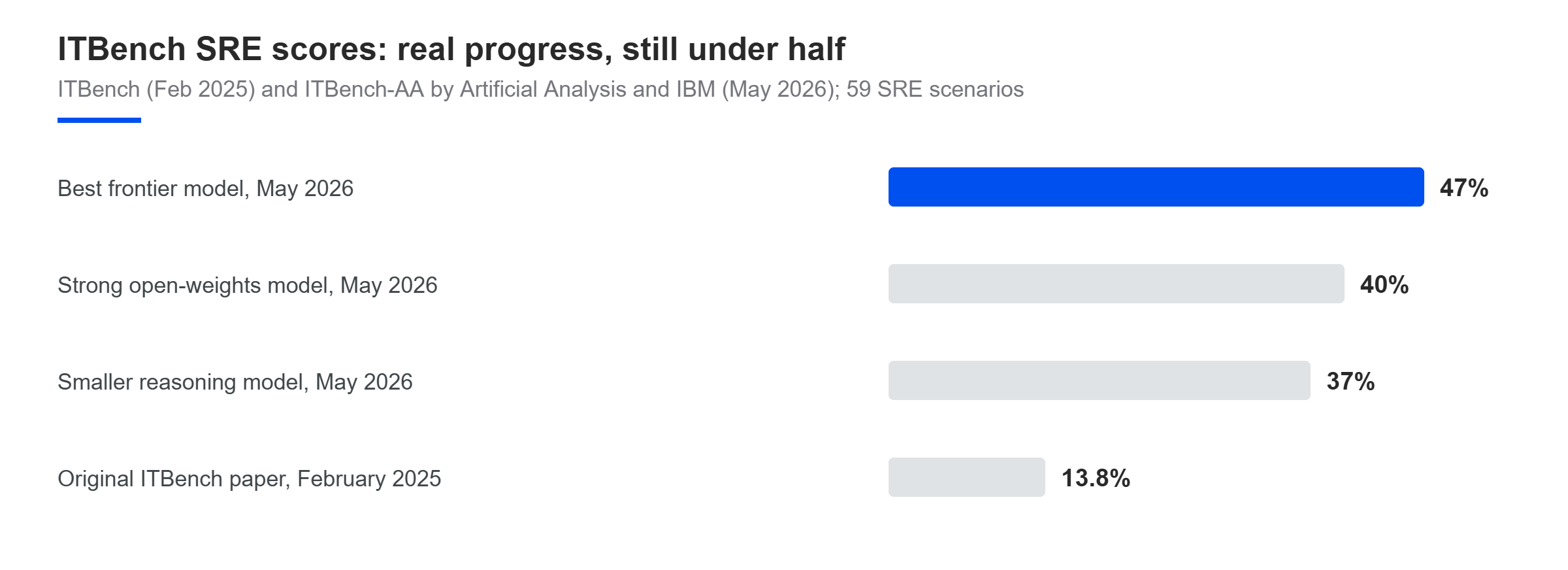
Three things in those results matter for planning. The improvement is genuine and fast: roughly 14% to 47% in fifteen months. The top of the field is tightly packed, with several models between 40% and 47%, which suggests the limit is the task rather than any one lab’s model. And the scoring is strict, awarding nothing for a run that misses the true root cause, which is the right standard for incident response, where a confident wrong answer costs more than no answer.
Cost varies by an order of magnitude at similar accuracy. The leading frontier result came in around $5.38 per task, while a strong open-weights model reached 40% at $1.23 and a smaller reasoning model reached 37% at $0.14. For a team running agents across every page, that spread decides whether the economics work.
The survey data points the same way. Catchpoint’s SRE Report 2026, covering 418 reliability professionals, found 49% saying AI had decreased toil, 35% reporting no change and 16% saying toil had increased, and summarized it as follows: AI does not remove toil automatically, it redistributes it. Only 13% described themselves as very or extremely confident in their ability to monitor AI reliability.
The authority ladder
The mistake that ends AI SRE programs is granting an agent write access to production on the strength of a demo. The pattern that works treats authority as something earned in stages, with evidence required at each one.
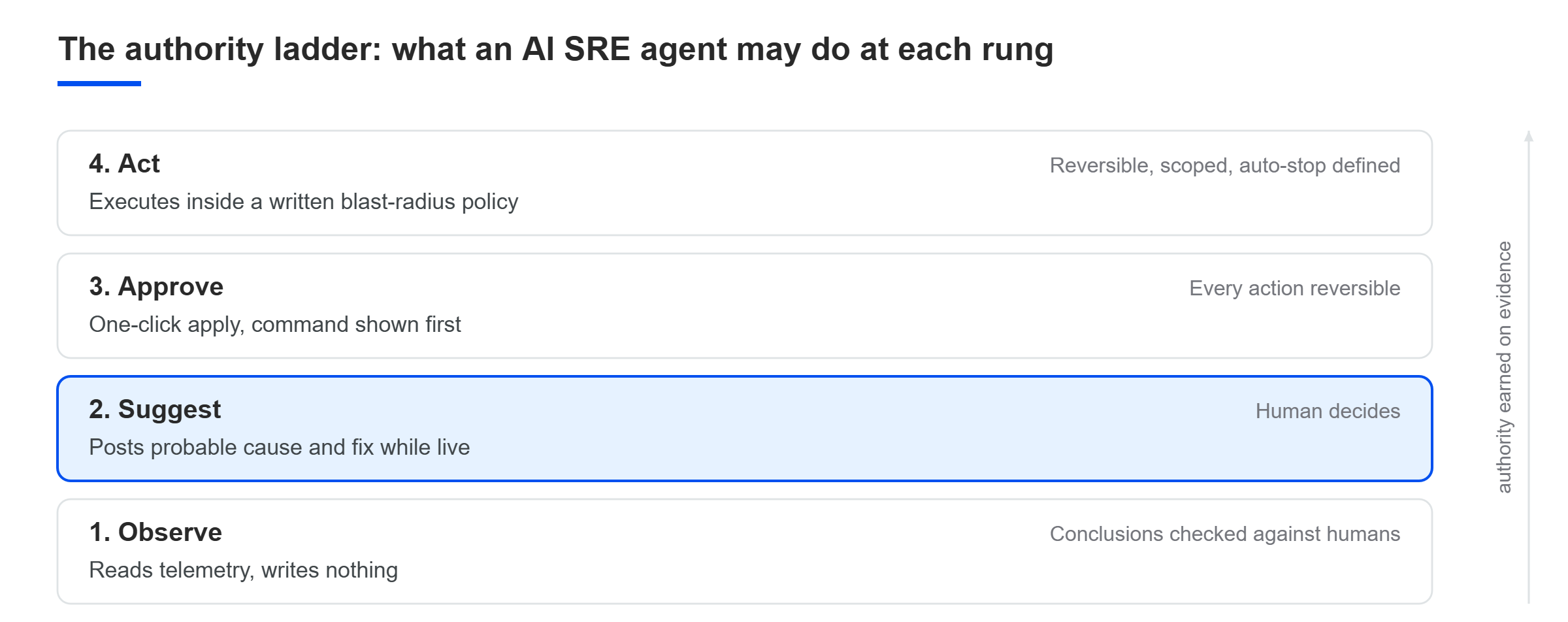
At the observe rung, the agent reads telemetry and writes nothing. It produces an investigation summary attached to the incident after the fact, and the only question you are answering is whether its conclusions match what the humans found. Run this for a month on real incidents before going further.
At the suggest rung, the agent posts its probable cause and proposed remediation into the incident channel while the incident is live. The human decides. This is where most organizations should expect to sit for a while, and where most of the time saving actually comes from, because the agent is doing the search while the engineer reads.
At the approve rung, the proposed remediation becomes a one-click action with the command visible before it runs. The gate is that every action is reversible and the scope is shown.
At the act rung, the agent executes within a written blast-radius policy: which services, which actions, what change size, what time of day, and what automatically stops it. Restarting a single stateless pod in a canary deployment is a reasonable first entry. Failing over a primary database is not.
The reason to make the ladder explicit is that it converts a trust question into an evidence question. “Can we let it act?” has no answer. “Has it proposed the right cause on 40 of the last 50 incidents in this service class?” does.
The 2026 AI SRE landscape
The market splits into agents built for investigation, incumbents adding agents to the telemetry they already hold, and open-source harnesses.
| Platform | Approach | Typical fit |
|---|---|---|
| Resolve AI | Multi-agent investigation testing hypotheses in parallel; $125M Series A at a $1B valuation, founded by former Splunk executives | Organizations buying investigation as a standalone capability |
| Traversal | Builds a model of the production environment and walks dependency chains many hops deep | Complex distributed estates with deep service graphs |
| Cleric | Keeps operational memory of past resolutions, read-only by default | Teams wanting a cautious starting posture |
| Datadog Bits AI | Reasons over telemetry already in Datadog, generally available since December 2025 | Teams whose operations live in Datadog |
| Dynatrace | Runs deterministic topology analysis before generative reasoning, grounded in its own dependency map | Enterprises standardized on Dynatrace |
| New Relic SRE Agent | Incident war-room workflow through chat tools, with root cause analysis | New Relic estates with chat-centred incident process |
| AWS DevOps Agent | Generally available since March 2026, with governance controls and MCP extensibility | AWS-centric environments |
| K8sGPT and HolmesGPT | Open source; scan clusters, read alerts and runbooks, and draft cause narratives | Teams validating the idea before buying |
A caution that applies across the category: most vendor accuracy and MTTR claims are published without methodology, sample size or definitions. A figure like “82% accurate root cause” has no stated basis for what counted as accurate or across how many incidents. Treat those numbers as marketing until a vendor will run against your own incident history, which several will do in a proof of concept.
What changes for the on-call engineer
The job shifts from investigator to reviewer. When an agent arrives with a cause and a proposed fix, the engineer’s work is to judge whether the reasoning holds, which is a different skill from knowing which dashboard to open, and a harder one to build in juniors who never had to do the search themselves.
That creates two obligations. The agent has to show its working, which is why Grafana’s finding that 95% of practitioners want AI to explain its reasoning is a product requirement rather than a preference. And the team needs deliberate practice on investigations the agent handled, or the capability to catch its mistakes decays. Catchpoint found only 6% of teams have protected learning time, which is the constraint most likely to bite in two years.
Alert quality still dominates everything. Grafana’s respondents named alert fatigue the single biggest obstacle to faster incident response, at 30%, nearly double the next answer, and the top barrier to AI adoption in operations was the manual effort required to give the AI enough context, at 26%. An agent pointed at a noisy, poorly instrumented estate inherits the noise.
What has to be true first
Four prerequisites decide whether an AI SRE deployment produces value or a new source of incidents.
Telemetry has to be consistent. Standard metric names, trace propagation across service boundaries, structured logs with stable fields. An agent correlates on what it can parse.
The service graph has to be current. Investigation depends on knowing what calls what. An agent reasoning from a topology six months stale will blame the wrong dependency convincingly.
Change data has to be joined to the telemetry. Most incidents follow a change, and an agent that cannot see deploys, flag flips and configuration edits is missing the single most predictive signal.
Runbooks have to exist in a form a machine can read. An agent that can find the cause and has no documented remediation produces a diagnosis and no resolution.
Teams that skip these and buy the agent first usually conclude the technology does not work, when what failed was the data underneath it.
How Compunnel Digital helps
Compunnel Digital builds the reliability foundation that AI SRE agents depend on, and governs the AI running on top of it.
- Managed SRE and AIOps works in four areas: reliability assessment of operational maturity and incident patterns, observability architecture covering metrics, logs and traces across environments, AIOps integration applying machine learning to event correlation, anomaly detection and root-cause analysis, and an SRE operating model with SLOs, SLIs, error budgets and reliability governance.
- Applied AI and Agentic Systems matters here because an AI SRE agent is itself a production AI system that needs governing. ModelGuard™ is the governance layer that ships with every Compunnel AI engagement, and the Autonomous Operations and Agentic AI offering covers multi-step agent workflows with AgentWeave™ as the agent foundation.
- Cloud-native accelerators: PlatformX™ supplies the observability and platform engineering patterns an agent reads from, and ShieldCI™ embeds security gates and detection into CI/CD pipelines so change data is captured where an investigation can use it.
- On AWS Compunnel brings 650+ certified experts and more than 450 cloud transformations delivered, and on Azure 1,000+ Microsoft certifications with managed operations and 24×7 monitoring.
If you are evaluating an AI SRE tool, or you have one that is not earning its keep, talk to our team about a reliability and observability assessment.
Frequently asked questions
What is an AI SRE?
An AI SRE is an agent that performs the investigation work of a site reliability engineer: receiving an incident, deciding what telemetry to examine, forming and testing hypotheses, and naming a probable root cause with a proposed remediation. It describes a capability rather than a job title, and it currently operates under human review in nearly all production deployments.
How accurate are AI SRE agents?
On ITBench, the public benchmark built by IBM Research and the University of Illinois, the best frontier model resolved 47% of 59 SRE scenarios as of May 2026, with every frontier model below 50% and no credit for runs that miss the true root cause. Vendor claims are considerably higher and are generally published without methodology or sample size.
Will AI replace site reliability engineers?
The evidence does not support that. Catchpoint’s 2026 report found median toil rising to 34% of SRE time even as 49% of respondents said AI had reduced their toil, which suggests the work is being redistributed rather than removed. The role is shifting toward reviewing machine-proposed conclusions and designing the systems agents operate within.
Is AI SRE the same as AIOps?
No. AIOps applies machine learning to operations data to reduce noise and rank probable causes, producing a better queue for a human. AI SRE agents carry out the investigation itself, choosing what to query and testing hypotheses. AIOps narrows the search space; an AI SRE agent searches it.
What do we need before deploying an AI SRE agent?
Consistent telemetry with standard naming and trace propagation, a current service dependency graph, change and deployment data joined to that telemetry, and machine-readable runbooks. Agents inherit the quality of the data underneath them, and an agent on poor telemetry investigates confidently in the wrong direction.
Conclusion
Agentic AI is changing site reliability work, and the change is more specific than the category name suggests. Agents are getting measurably better at investigation, from under 14% to 47% on the same benchmark in fifteen months, and they still miss more than half the time, which makes the human an approver rather than a bystander. The organizations getting value are the ones that fixed telemetry, topology and change data first, then moved an agent up a defined ladder of authority on evidence rather than enthusiasm.
Explore how our Cloud, Platforms and Engineering practice builds the reliability foundation that agentic operations run on.
Sources
- Saurabh Jha, Ruchir Puri and colleagues (IBM and University of Illinois at Urbana-Champaign), ITBench: Evaluating AI Agents across Diverse Real-World IT Automation Tasks, arXiv:2502.05352, 7 February 2025 (94 scenarios)
- Artificial Analysis and IBM, ITBench-AA launch and SRE leaderboard, 27 May 2026 (59 SRE scenarios, three runs per task)
- Catchpoint, SRE Report 2026, February 2026 (418 reliability professionals)
- Grafana Labs, Fourth annual Observability Survey, 18 March 2026 (1,363 respondents in 76 countries)
- Dynatrace, State of SRE and Platform Engineering 2026, August 2026 (919 IT leaders; vendor research)
- TechCrunch, AI SRE Resolve AI confirms $125M raise at unicorn valuation, 4 February 2026
- AWS, AWS DevOps Agent is now generally available, March 2026
- Mezmo, The 2026 AI SRE market map, 22 June 2026 (vendor-published market overview)
- Google, Site Reliability Engineering, Chapter 5: Eliminating Toil