
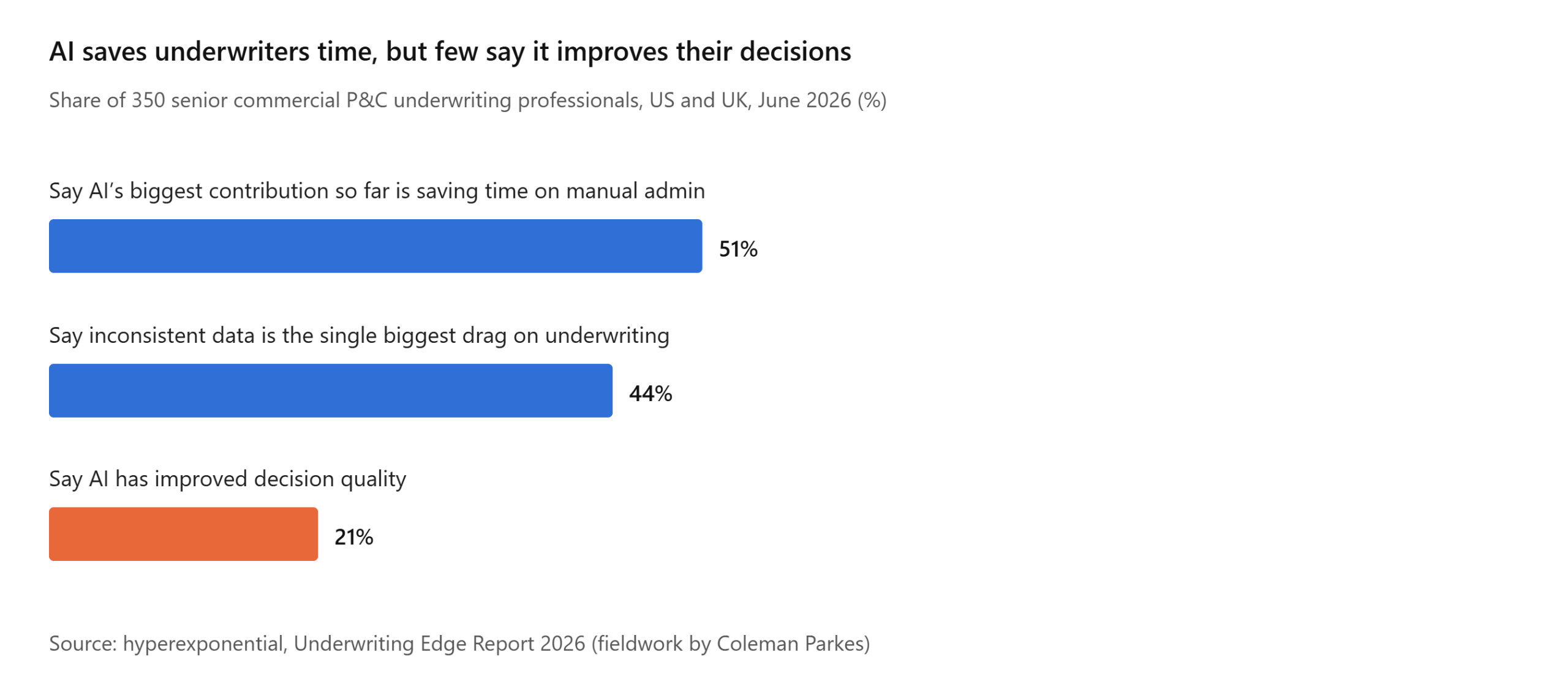
Many insurers already use AI in underwriting. In Convr’s 2026 survey of 211 commercial insurance professionals, 53.6% said AI is already deployed in at least one production underwriting workflow. The results so far are narrower than the investment suggests. In hyperexponential’s Underwriting Edge 2026 report, a survey of 350 senior commercial P&C underwriting professionals in the US and UK, 51% said AI’s biggest contribution so far is saving time on manual admin. Only 21% said it has improved decision quality.
The same report points to the reason. Inconsistent data was the single biggest drag on underwriting, cited by 44%. Most of that data arrives in the broker’s submission: an email, a standard application form, a claims history from the previous insurer and a few spreadsheets. If AI can’t read those documents accurately, every model downstream works from a partial picture.
This article explains, in plain terms, how AI turns a submission into data an underwriter can trust, where it goes wrong, and how to move AI from saving admin time to improving underwriting decisions.
Key takeaways
- AI is already in production underwriting at many insurers. So far most of the benefit is time saved on admin, and few underwriters say it has improved their decisions.
- Inconsistent submission data is the biggest drag on underwriting, so the quality of document extraction sets a ceiling on what any underwriting AI can do.
- The three hardest inputs are the application form (usually an ACORD form), the broker’s email and spreadsheets, and the loss run, a report of past claims.
- Speed at intake changes who wins the business: in the Ivans 2026 survey, 90% of independent agents said they had reduced business with a carrier because of submission friction.
- Keep a person in the loop on low-confidence fields, and link every extracted value to its source page. Regulators in 29 US jurisdictions now expect insurers to govern how they use AI.
Compunnel Digital builds the document AI, data platforms and governed AI workflows that underwriting teams use to close this gap. Talk to our team about a pilot on your own submissions, or read how we help below.
Why AI in underwriting depends on the submission
An underwriter decides whether to insure a business and at what price. To do that, they need facts: what the business does, where its buildings are and what they’re worth, how many vehicles and employees it has, and what claims it has made in the past five years. All of those facts arrive in the broker’s submission, and very few arrive as clean data.
A typical commercial submission includes:
- the broker’s email, which often carries the latest changes, such as a new effective date or a target premium;
- an application on ACORD forms, the industry’s standard insurance application templates;
- schedules in Excel, such as a list of locations with building values or a list of vehicles and drivers;
- loss runs, which are reports from previous insurers listing every past claim and what it cost.
Someone has to turn that pile into structured fields before a rating engine, an appetite model or an AI assistant can use it. Today that someone is often the underwriter. In Sixfold’s 2026 Future of Underwriting survey of 543 underwriting professionals, 83% of underwriters said they still spend at least 30 minutes chasing missing information from brokers on a single risk.
Brokers feel the delay from the other side. In the Ivans 2026 Insurance Agency-Carrier Connectivity Trends survey of 702 independent agents, rekeying risk data into multiple carrier portals was the top pain point, cited by 74%, and commercial submission automation was the capability agents most wanted from carriers, at 79%.
This is why document extraction matters to an AI strategy. An AI model that scores risk appetite, flags a large loss or suggests a price is only as good as the fields it receives. If the extraction step misses half the locations on a schedule or misreads a claim total, the model’s output looks confident and is wrong.
How Compunnel Digital helps
Compunnel Digital builds the data and document layer that AI in underwriting depends on, then puts governed AI workflows on top of it.
- Enterprise Knowledge and Document AI: DocuIntel™ extracts and structures data from unstructured documents, so applications, schedules and loss runs become fields your systems can use.
- Agentic workflows: AgentWeave™ orchestrates multi-step agentic AI work such as document routing and triage, with an audit trail on every decision. In a claims operations deployment, it cut average resolution time from 14 days to 4 hours and processed 78% of claims under $50K autonomously.
- A unified insurance data layer: for a multi-line US P&C carrier, Compunnel integrated more than 12 data sources and reports a 40% improvement in data quality and 70% faster insight availability.
- Responsible AI, governance and assurance: ModelGuard™ monitors every model and agent in production with drift detection, audit trails and policy validation.
Across its AI accelerators, Compunnel reports up to 70% less manual effort in targeted back-office workflows. If your underwriters are still rekeying submissions, talk to our team about a pilot on your own documents.
What AI does with each part of a submission
Each document type poses a different problem for AI. Here is what each one is, what AI does with it, and where it tends to go wrong.
The application form
ACORD forms are the standard templates US brokers use to apply for commercial insurance. The ACORD 125 covers the business itself, and separate sections cover property, general liability, auto and workers’ compensation. Because the layout is standard, they are the easiest documents for AI to read.
The catch is that they rarely arrive as tidy digital forms. Many are printed, signed and scanned. Different agency systems use different editions of the same form, so a field can move from one version to the next. Handwritten answers and ticked boxes carry real underwriting meaning. Modern document AI combines layout analysis, text recognition and a language model, so it can read a scanned or unfamiliar edition and return a confidence score for each field. It should also cross-check forms: the locations on the main application should match the buildings in the property section.
The broker’s email and spreadsheets
The email often holds the newest information in the submission, written as free text: “the client just added a warehouse in Ohio.” AI is good at pulling dates, premiums and changes out of that kind of prose, which older template-based systems couldn’t read at all.
Spreadsheets are harder than they look. A property schedule can list hundreds of locations, and every broker names the columns differently. AI has to map those columns to a standard format, clean up addresses and translate descriptions such as “brick, built 1972” into the codes a pricing model expects. When two documents disagree, such as a building value on the schedule that doesn’t match the application, the system should flag it for a person to resolve.
The loss run
A loss run is the claims history an insurer issues for a policy. It is the most important document for judging risk, and the hardest for AI, because there is no standard layout. Each insurer uses its own format and labels, so “paid loss” on one report is “indemnity paid” on another.
AI reads each report, finds the claims table and maps every insurer’s labels to one consistent set of fields. Simple arithmetic catches most errors: for each claim, the amount paid plus the money held in reserve should equal the total incurred, and the totals should match the report’s own summary. When those checks fail, the claim goes to a person. Once loss runs are consistent, AI can do what underwriters want from them: spot large losses, show claim trends year by year and compare losses with premium.
From faster intake to better decisions
Clean extraction is where AI in underwriting starts. The value grows as that data reaches the decisions that follow.
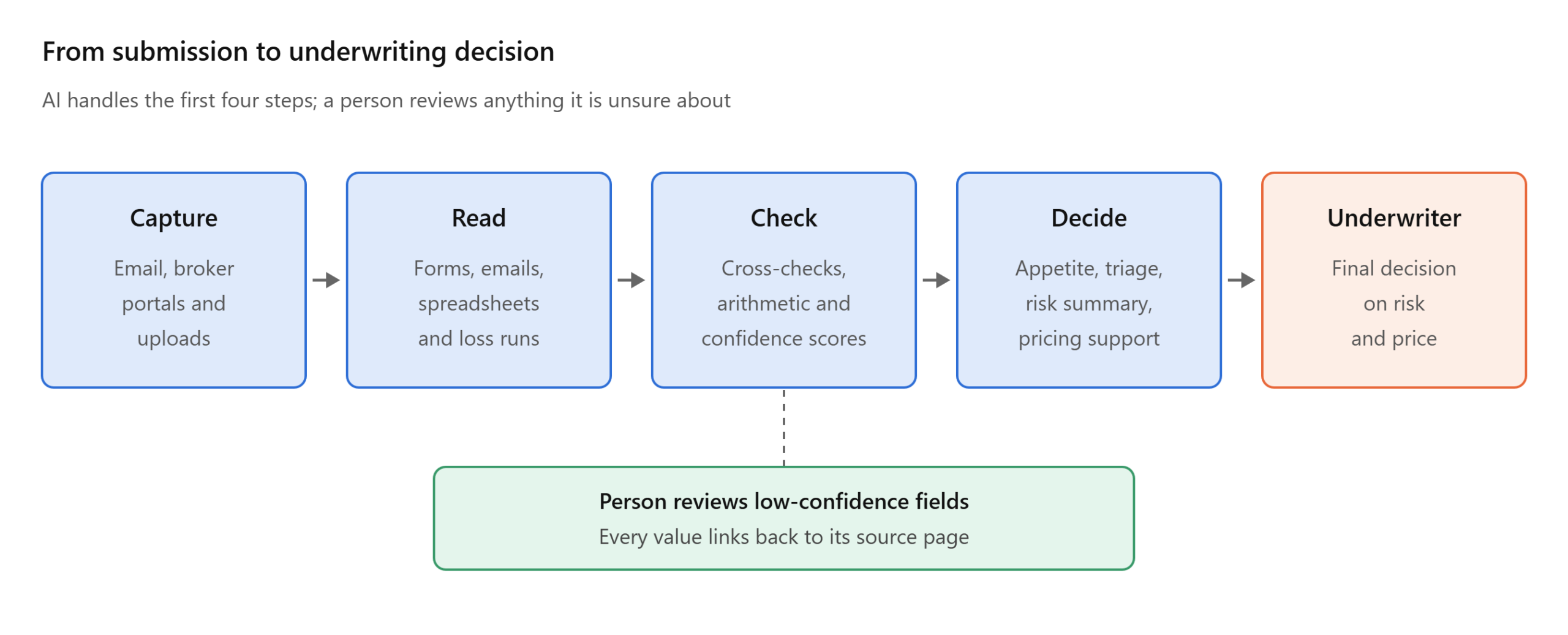
Fast, accurate intake first changes which submissions get worked. Once every submission is structured, AI can check it against the insurer’s appetite, route it to the right desk or decline it early, and rank the queue so underwriters see the best-fit risks first. Arch Insurance described this effect in a May 2026 case study written by its AI intake vendor, Cytora: intake-to-decision time fell by 70%, from two to three days to two hours, and quotes moved to same-day turnaround. An Arch executive is quoted as saying that being first to quote brings a 50% higher conversion rate.
It also changes how much a team can handle. At AIG, chief executive Peter Zaffino told investors in February 2026 that the Lexington unit had reached more than 370,000 submissions, with an ambition of 500,000 by 2030.
The decision step is where the remaining gap sits. When underwriters receive a complete, consistent file, AI assistants can summarize the risk, point out anything unusual in the loss history and compare the account with similar ones the insurer has written. That is the shift from saving admin time, which 51% of underwriters already report, to improving decision quality, which only 21% do today.
Keeping AI in underwriting trustworthy
AI will misread some values, and a wrong building value or claim total flows straight into the price. Three habits keep that risk under control:
- Set a confidence threshold for every field that affects price or appetite, and send anything below it to a reviewer.
- Link every extracted value to the exact spot in the source document, so an underwriter or auditor can check it in seconds, the same principle behind enterprise search that cites its sources.
- Test the system on a set of your own real submissions, labeled by underwriters, and rerun that test whenever a model, prompt or rule changes.
Regulators expect the same discipline. According to the NAIC’s adoption map, 29 jurisdictions had adopted its model bulletin on insurers’ use of AI as of October 8, 2026. Colorado’s amended Regulation 10-1-1, effective October 15, 2025, sets governance and risk management requirements for insurers’ use of external data and models in life, private passenger auto and health insurance. In Europe, AI used for risk assessment and pricing in life and health insurance is classed as high risk under the EU AI Act, and the 2026 AI Omnibus moved the deadline for those rules to December 2, 2027.
How to tell whether it’s working
Measure the outcomes underwriters and brokers feel, field by field:
- accuracy on the fields that drive price and appetite, such as building values, payroll and incurred losses;
- the share of submissions that pass without a person retyping anything;
- time from receipt to triage, and from receipt to quote;
- how much of each submission you capture as data, beyond the minimum fields;
- quote and win rates on submissions that fit your appetite.
Many insurers skip this step. Capgemini’s World Property and Casualty Insurance Report 2026, based on a survey of 344 P&C executives, found that 42% of insurers track no AI metrics and only 10% of the industry is successfully scaling AI. Its finding that only 12% of insurers report very high data maturity explains much of the gap.
Where to start
- Pick one line of business and one document type, such as loss runs for a casualty team or applications and schedules for a property desk (our AI use case prioritisation framework can help you choose).
- Agree with underwriters on the fields that matter and the checks each field must pass.
- Build a labeled test set from your own recent submissions, and record today’s accuracy and handling time.
- Run a pilot with human review on every field, then automate field by field as accuracy is proven. Agree the success metrics before the pilot starts, so it does not stall between the demo and the contract.
- Connect the output to triage, rating and the underwriting workbench so nobody retypes it, then add the next document type.
Frequently asked questions
How is AI used in underwriting?
Insurers use AI in underwriting to read submission documents, check new risks against appetite, rank the submission queue, summarize risks for underwriters and support pricing. Most of today’s value comes from the first step, turning documents into structured data, because every later use depends on it.
What is a loss run, and why is it hard for AI?
A loss run is a report from an insurer listing a policyholder’s past claims, including dates, amounts paid and money held in reserve. There is no industry-standard layout, so AI has to map each insurer’s labels to one format and check that the numbers add up before anyone relies on them.
Can AI read scanned or handwritten ACORD forms?
Yes, within limits. Current document AI can read scans, ticked boxes and most handwriting, and gives a confidence score for each field. Low-confidence values, especially those that affect price, should go to a person for review.
Does AI replace underwriters?
No. AI takes over rekeying, sorting and first-pass checks. The underwriter still decides whether to take the risk and at what price, with a more complete file and more time to think about it.
What regulations apply to AI in underwriting?
In the US, 29 jurisdictions have adopted the NAIC model bulletin on insurers’ use of AI, and some states, such as Colorado, have their own rules. In the EU, AI used to assess risk and set prices in life and health insurance is classed as high risk under the AI Act.
Conclusion
AI in underwriting is already saving time, but most insurers have yet to see it improve decisions. The gap starts at the submission. When AI reads applications, emails, spreadsheets and loss runs accurately, checks the numbers and shows where each value came from, underwriters get a complete file faster and the models that follow get data they can rely on.
Explore how our Applied AI practice takes document AI and agentic workflows from pilot to production.
Sources
- hyperexponential, Underwriting Edge Report 2026, September 2026 (350 senior commercial P&C underwriting professionals, US and UK, fieldwork June 2026)
- Insurance Business, Insurers have the AI tools, but they don’t have the confidence, June 2026 (Convr survey of 211 commercial insurance professionals)
- Carrier Management, Sixfold Future of Underwriting survey, August 2026 (543 underwriting professionals)
- Ivans, 2026 Insurance Agency-Carrier Connectivity Trends Survey, August 2026 (702 independent agents)
- Ivans, How Arch Insurance transformed submission intake with AI, May 2026
- Carrier Management, AIG Q4 2025 earnings coverage, February 2026
- Capgemini, World Property and Casualty Insurance Report 2026, May 2026
- NAIC, Implementation of the NAIC Model Bulletin on the Use of AI Systems by Insurers, status as of October 8, 2026
- Colorado Division of Insurance, Amended Regulation 10-1-1
- EIOPA, Opinion on AI governance and risk management, August 2025, and National Law Review, EU Digital Omnibus on AI enters into force, July 2026