
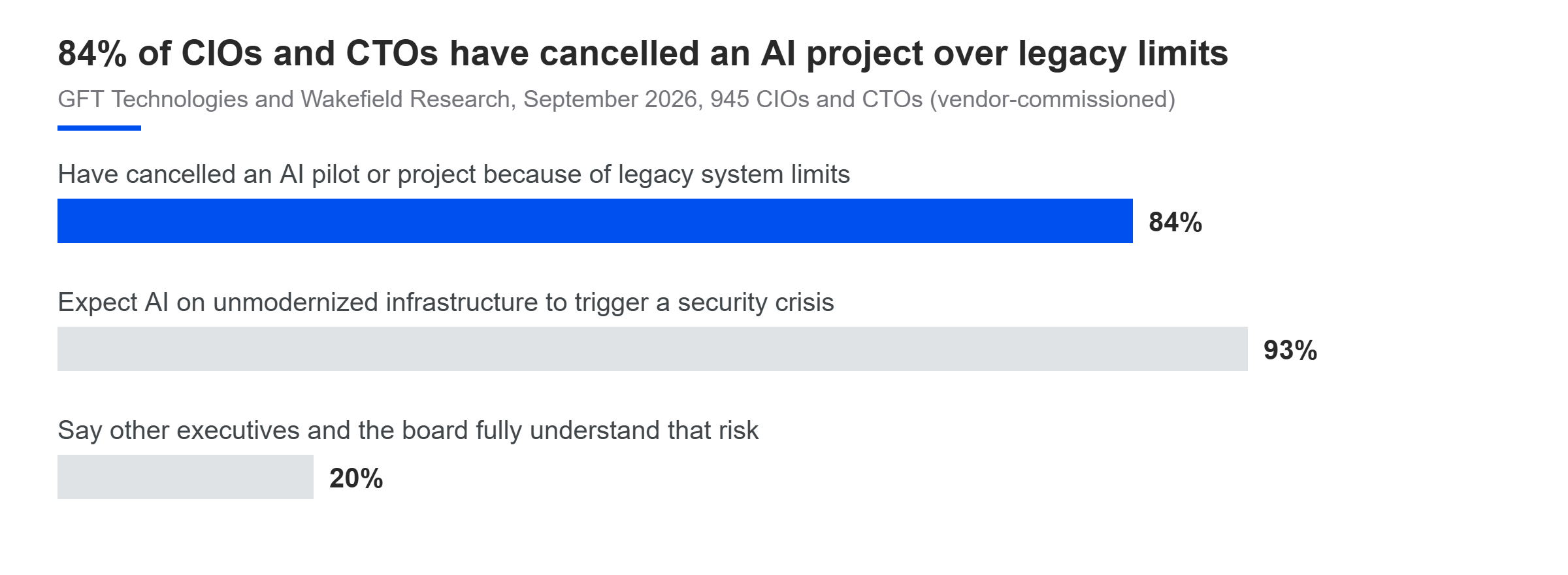
Legacy applications are now cancelling AI projects. In a September 2026 survey of 945 CIOs and CTOs at companies with at least $500 million in revenue, commissioned by GFT Technologies and fielded by Wakefield Research, 84% said limitations in their legacy systems had caused their organization to cancel an AI pilot or project, 93% expect running AI on unmodernized infrastructure to trigger an enterprise-wide security crisis eventually, and only 20% say their fellow executives and board fully understand that risk. A year earlier, Pegasystems found 78% of IT decision makers agreeing that the time, money and effort spent maintaining legacy applications could be spent more productively.
That is why application modernization has moved from a cost line to a prerequisite for anything a company wants to do with AI, data or customer experience. This article defines application modernization, summarizes the approaches, and then spends most of its length on the part that decides whether a program works: a six-stage engineering roadmap from portfolio assessment to measured operation.
Key takeaways
- Application modernization changes how an application is built, deployed and run so it meets current business, security and AI requirements. It covers code, architecture, data, platform and delivery practice, which is wider than moving it to new hosting.
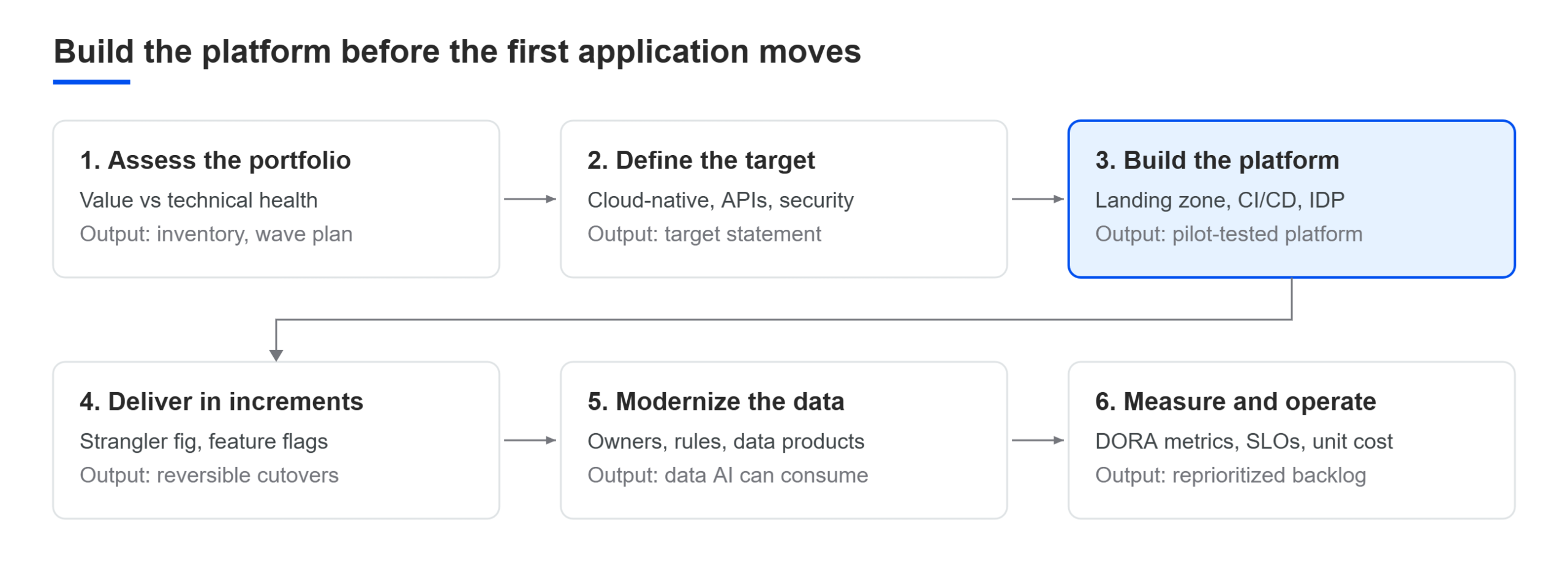
- The roadmap has six stages: assess the portfolio, define the target architecture, build the platform first, deliver in increments, modernize the data alongside the code, and measure and operate.
- Platform first is the stage most programs skip. The 2025 DORA report found 90% of organizations have adopted platform engineering and called a high-quality internal platform the essential foundation for AI success.
- Incremental delivery is the risk control. The strangler fig pattern replaces an application piece by piece while the old system keeps running.
- AI tooling shortens the mechanical work, and the DORA report also found AI adoption still correlates with lower delivery stability. The roadmap’s test and measurement stages are what keep the speed safe.
What application modernization is
Application modernization is the process of updating an existing application so it meets current requirements for agility, cost, security, scalability and integration. Infrastructure migration moves an application to new hardware or a cloud. Modernization changes the application itself: its code, its architecture, how it stores and exposes data, how it is deployed and how it is operated. A migration can leave every line of technical debt intact. A modernization is judged on whether the debt is gone.
Gartner’s April 2026 guidance starts from diagnosis: “application modernization approaches vary substantially based on the underlying problems they are intended to address,” and the aim is to “achieve intended outcomes within acceptable cost, risk and impact constraints.” That is the principle behind the roadmap below. Every stage exists to make the diagnosis accurate, the target explicit and the delivery safe.
The business case has also changed. Forrester’s 2026 budget planning guidance urges technology leaders to “declare bankruptcy on legacy tech debt,” noting that it “both increases IT costs and risks while slowing down the delivery of new capabilities.” IBM’s Institute for Business Value found in November 2025 that accounting for technical debt in AI plans can boost returns by 29%. The argument for modernization is now what legacy applications block, and the strongest thing they block is AI.
The approaches, briefly
There are well-known families of modernization approach, and they are worth knowing before the roadmap because stage one assigns one to each application.
- Keep and improve the code: refactor to remove technical debt while behavior stays the same.
- Change the platform: rehost or replatform onto new infrastructure, runtimes or managed services with limited code change.
- Change the structure: rearchitect a monolith into services, APIs and events so it can scale and release at the pace the business needs.
- Start again: rebuild with the same scope, or replace with a product or SaaS when the capability is a commodity.
- Wrap and wait: encapsulate the application behind APIs so new systems can use it while a deeper fix is planned.
None of these is a plan on its own. The approach is the output of an assessment, and most portfolios end up with a mix. What separates programs that finish from programs that stall is the engineering roadmap around the choice, which is the rest of this article.
How Compunnel Digital helps
Compunnel Digital runs every stage of the roadmap, with accelerators for the platform and delivery work that repeats from program to program.
- Cloud migration and modernization covers the assessment, target architecture and application modernization through cloud-native engineering, migration automation and platform modernization frameworks.
- Cloud-native accelerators build the platform stage. PlatformX™ supplies microservices patterns, containerization templates, Kubernetes orchestration frameworks and event-driven architecture blueprints. ShieldCI™ embeds security gates into CI/CD pipelines, and SecureLanding™ provides secure landing zones as infrastructure as code across AWS, Azure and GCP. Compunnel reports 40% faster migrations and 10x faster environment provisioning with these accelerators.
- Automation modernisation builds the test safety net that incremental delivery depends on, with self-healing automation and AI-driven test generation. Compunnel reports an 80% reduction in automation maintenance and a threefold increase in tester productivity.
- Managed SRE and AIOps runs the measure-and-operate stage, with observability, SLOs and error budgets. Compunnel reports a 72% reduction in critical incidents for an enterprise SaaS provider.
Two engagements show the roadmap in practice. For a wealth management platform, Compunnel modernized a legacy front end into a React ecosystem with reusable components and real-time updates, delivered incrementally with zero downtime during migration. For a global mobility manufacturer, Compunnel built a cloud-native MLOps platform on Azure and reports a 40% reduction in AI model deployment time and 50% faster data processing.
If you have a modernization backlog and an AI roadmap waiting behind it, talk to our team about a portfolio assessment.
The application modernization roadmap
Each stage produces something a leadership team can see before the next stage is funded. The order matters: programs that start at stage four, with a flagship rearchitecture, usually discover stages one to three the hard way.
Stage 1. Assess the portfolio
List every application with its business owner, users, dependencies, technology, support status and run cost. Then score each one on two axes: business value (how much the business depends on it and how much it will need to change) and technical health (how hard it is to change, secure and run). The four quadrants give you the first-cut decision. High value and poor health is where modernization investment goes. Low value and poor health is a retirement candidate. High value and good health needs maintenance and a watch on support dates. Low value and good health can be tolerated.
For the high-value applications, name the constraint: cost, risk, agility, scale, skills or AI readiness. The constraint, together with the quadrant, picks the approach. The output of the stage is a scored inventory, a wave plan ordered by value and risk, and a business case per wave.
Stage 2. Define the target architecture
Write down what “modern” means for your estate before anyone builds anything, because every team will otherwise define it differently. In 2026 the target has largely settled. CNCF’s annual survey, published in January 2026, found that 82% of container users now run Kubernetes in production, up from 66% in 2023, that 98% of surveyed organizations have adopted cloud-native techniques, and that 66% of organizations hosting generative AI models run some or all of their inference on Kubernetes. The platform that runs modern applications is the platform that runs AI.
A workable target architecture statement covers the service model (containers on Kubernetes, serverless, or managed PaaS, and when each applies), the integration style (APIs and events, with contracts), the twelve-factor conventions for configuration, statelessness and logging, the data ownership rules, and the security baseline.
On the last point, CISA and the NSA’s June 2025 guidance asks software producers to plan for memory-safe languages, noting that adoption “does not require existing code to be completely rewritten,” and Veracode’s 2026 State of Software Security, drawn from 1.6 million applications, found 82% of organizations carrying security debt, with third-party and open-source dependencies accounting for 66% of the most dangerous, longest-lived flaws. Modernization is usually the only practical moment to retire those dependencies, so the target architecture should say which ones go.
Stage 3. Build the platform first
This is the stage most programs skip, and the one that most often explains a stalled program. Modernized applications need somewhere to land: a secure landing zone, CI/CD pipelines with security gates, observability, secrets management and an internal developer platform that gives teams a paved road. Build it before the first application moves, as infrastructure as code, so every later service inherits the same controls.
The evidence for platform first is strong. Google Cloud’s 2025 DORA report, based on nearly 5,000 technology professionals, found that 90% of organizations have adopted at least one internal platform and reported “a direct correlation between a high quality internal platform and an organization’s ability to unlock the value of AI, making it an essential foundation for success.” Gartner predicted in 2023 that by 2026, 80% of software engineering organizations would establish platform teams as internal providers of reusable services, and in 2025 added that by 2027, 70% of organizations with platform teams will include GenAI capabilities in their internal developer platforms. The output of the stage is a platform a pilot team has used end to end.
Stage 4. Deliver in increments
Replace the application piece by piece while the old one keeps running. Microsoft’s Azure Architecture Center describes the strangler fig pattern as a way to “incrementally migrate a legacy system by gradually replacing specific pieces of functionality with new applications and services,” until “the new system eventually comprises all of the old system’s features.” A facade routes traffic between old and new, so each cutover is small and reversible.
Three practices make increments safe. Characterization tests capture the current behavior of the legacy code before anything changes, so the new implementation can be proved equivalent. Feature flags and parallel runs let a new service take real traffic while the old one stays available. And contract tests between services catch the integration breaks that unit tests miss. If the existing test automation is brittle, rebuild it first. It is the safety net for every later stage.
Stage 5. Modernize the data alongside the code
Applications modernized on top of untrusted data produce faster wrong answers. Decouple the data from the applications that own it, define data owners and quality rules, and expose it through APIs or data products that AI workloads can consume. Plan the data migration with the same discipline as the application cutover: reconciled, rehearsed and reversible. This stage is where AI readiness is won or lost, because the most common reason an AI project fails on a modernized application is that the data behind it was never modernized.
Stage 6. Measure and operate
Modernization is finished when the numbers move. DORA’s software delivery metrics are the standard yardstick: change lead time, deployment frequency, change fail rate, failed deployment recovery time and deployment rework rate. Add infrastructure cost per transaction, incident volume and developer onboarding time, and review the set every quarter to reprioritize the backlog. Operate the modernized estate with SRE practice, service-level objectives and error budgets, so reliability is managed as a number.
Where AI fits in the roadmap
AI tooling now does much of the reading, translating and testing that used to limit how fast a team could move. Gartner predicts that by 2028, 90% of enterprise software engineers will use AI code assistants, up from less than 14% in early 2024, and Stack Overflow’s 2026 Developer Survey, with more than 30,000 respondents, found 73% of developers who use AI coding tools use them daily.
The tooling now targets modernization directly. AWS Transform, generally available since May 2025, uses agentic AI for mainframe, VMware and .NET workloads, and AWS reports preview projects delivered up to four times faster. GitHub Copilot’s app modernization capability for Java and .NET, generally available since September 2025, assesses, transforms, patches and containerizes applications, which GitHub says takes days instead of months.
Two cautions belong in the roadmap. The DORA report found that AI adoption improves throughput and product performance but “does continue to have a negative relationship with software delivery stability,” and that 30% of respondents have little or no trust in AI-generated code. A Gartner peer poll of modernization leaders found 57% saying GenAI had made some noticeable improvements to their modernization, 16% saying it had significantly sped things up and 21% reporting no impact. AI speeds up stages four and five. Stages three and six, the platform and the measurement, are what make that speed safe.
Common failure modes
Teams that stall usually hit one of four problems. They modernize for its own sake and can’t show business value, so funding dries up: stage one was skipped. They rearchitect before fixing delivery, so new microservices release as slowly as the old monolith: stage three was skipped. They lose business rules buried in old code because nobody wrote characterization tests: stage four was rushed. Or they modernize the application and leave the data where it was, so the new system inherits the old reports: stage five was deferred. Each is far cheaper to prevent than to fix after cutover.
Frequently asked questions
What is the difference between application modernization and cloud migration?
Cloud migration moves an application to cloud infrastructure, sometimes without changing it. Application modernization changes the application’s code, architecture, data or delivery practices so it meets current requirements. Many programs do both, and migrating an unchanged application leaves its technical debt intact.
Where should an application modernization program start?
With a scored portfolio assessment, then the target architecture, then the platform. Starting with a flagship rewrite is the most common way to lose a year.
What is platform engineering, and why does it matter for modernization?
Platform engineering builds a self-service internal platform that gives developers standard, secure ways to build, deploy and run applications. The 2025 DORA report found 90% of organizations have adopted at least one platform and called it the essential foundation for AI success. Modernized applications need that platform to deliver the speed they promise.
How do we modernize without downtime?
Use the strangler fig pattern: route traffic through a facade, replace one capability at a time, run old and new in parallel, and keep each cutover small enough to reverse. Characterization tests prove the new piece behaves like the old one before it takes live traffic.
How do we know modernization is working?
Track DORA’s delivery metrics (change lead time, deployment frequency, change fail rate, failed deployment recovery time, deployment rework rate) alongside cost per transaction and incident volume, and compare them against the baseline captured in stage one.
Conclusion
Application modernization in 2026 is the work of removing the constraints that stop a business from using AI, data and modern delivery. The approaches are well known; the roadmap is what decides the outcome. Assess the portfolio, define the target, build the platform first, deliver in increments, modernize the data with the code, and measure what changed. AI tooling makes the mechanical stages faster, and the platform and the measurement are what keep that speed safe.
Explore how our Cloud, Platforms and Engineering practice builds the foundations modern applications run on.
Sources
- GFT Technologies and Wakefield Research, 84% of CIOs Have Canceled an AI Project Over Legacy System Limits, September 2026 (945 CIOs and CTOs, 19 countries; vendor-commissioned)
- Pegasystems and Savanta, Average Global Enterprise Wastes More Than $370 Million Every Year Through Technical Debt, October 2025 (500+ IT decision makers; vendor research)
- Gartner, Guide Application Modernization Success by Diagnosing Root Causes, April 2026
- Gartner, Top Strategic Trends in Software Engineering for 2025 and Beyond, July 2025
- Gartner, Hype Cycle Shows AI Practices and Platform Engineering Will Reach Mainstream Adoption, November 2023
- Gartner Peer Community, How has GenAI influenced your application modernization journey so far? (peer poll)
- Computer Weekly, Forrester urges IT leaders to dump technical debt, July 2025
- IBM Institute for Business Value, The tech debt reckoning, November 2025 (vendor research)
- CNCF, Annual Cloud Native Survey, January 2026
- Google Cloud, 2025 DORA Report: State of AI-Assisted Software Development, September 2025 (nearly 5,000 respondents), and DORA, DORA’s software delivery metrics, updated January 2026
- Microsoft Learn, Strangler Fig pattern, updated June 2026
- Adam Wiggins, The Twelve-Factor App
- CISA and NSA, Memory Safe Languages: Reducing Vulnerabilities in Modern Software Development, June 2025
- Veracode, 2026 State of Software Security, February 2026 (1.6 million applications; vendor telemetry)
- Stack Overflow, 2026 Developer Survey, October 2026 (30,000+ respondents)
- AWS, AWS Transform generally available, May 2025 (vendor announcement)
- GitHub, Copilot app modernization generally available for Java and .NET, September 2025 (vendor announcement)