
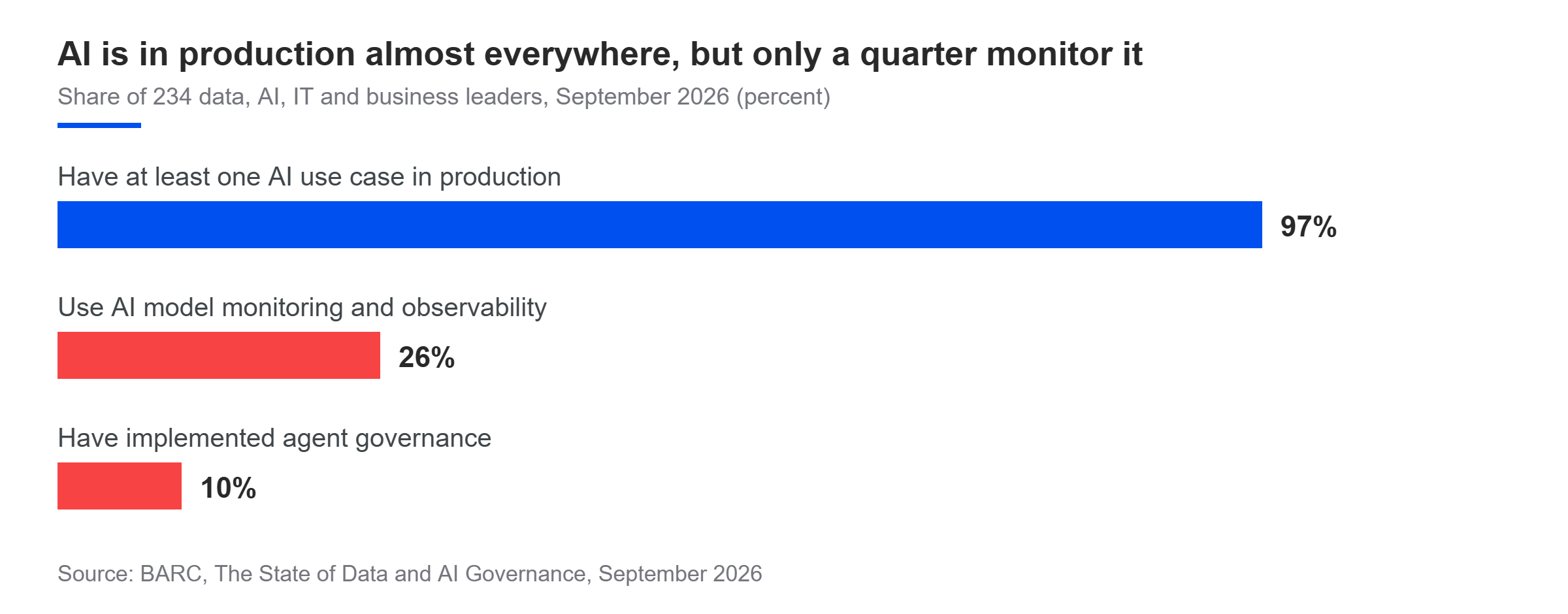
AI is in production at almost every organization, and most of it is running unwatched. BARC’s September 2026 survey of 234 data, AI, IT and business leaders found that 97% have at least one AI use case in production, but only 26% use AI model monitoring and observability, and 10% have implemented agent governance.
That gap has consequences. In OneTrust’s 2026 AI-Ready Governance Report, a survey of 1,200 senior decision makers in eight countries, 86% said their organization had experienced at least one AI-related incident in the past year. Stanford’s 2026 AI Index counted a record 362 publicly reported AI incidents in 2025.
Models change after they ship, and so does the world they were trained on. That is model drift, and catching it is the job of model drift monitoring. This article sets out what to measure for traditional machine learning models and for LLM and agent systems, how often to measure it, and what regulators now expect.
Model drift is the loss of accuracy a machine learning model suffers after deployment, when the data it sees in production, or the relationship between that data and the outcome, no longer matches what it was trained on. Model drift monitoring is the practice of measuring input data quality, input drift, output drift and live performance on a fixed schedule, so that loss is caught before it reaches users.
What this guide covers
Key takeaways
- Most AI runs without monitoring: 97% of organizations have AI in production, but only 26% monitor their models (BARC, September 2026).
- Model drift comes in three forms. Data drift is a change in the inputs, concept drift is a change in the relationship between inputs and outcomes, and prediction drift is a change in the outputs. Each needs its own measurement.
- For LLMs and agents, add quality and behavior metrics: groundedness, tool-call accuracy, failure rates, latency, token usage and cost. Gartner expects LLM observability investment to cover 50% of GenAI deployments by 2028, up from 15% today.
- Frequency follows traffic and risk. Hourly for high-volume real-time models, daily for most, weekly or monthly for low-volume batch models, and always after a data pipeline change or a provider model update.
- Regulators now expect it. The Federal Reserve’s SR 26-2 guidance (April 2026) calls for ongoing monitoring scaled to model materiality, and the EU AI Act requires a documented post-market monitoring system for high-risk AI.
What model drift is, and why it matters more now
A model is a snapshot of the data it was trained on. When the world moves, the snapshot stays still, and accuracy falls without any error message. Microsoft’s Azure Machine Learning documentation describes the three forms of model drift you need to watch:
| Type of drift | What changes | Example | How you detect it |
|---|---|---|---|
| Data drift | The distribution of the model’s input data | A lender’s applicants get younger; a retailer’s basket sizes shrink | PSI, KS test, Jensen-Shannon or Wasserstein distance per feature |
| Concept drift | The relationship between the inputs and the target | The same applicant profile now defaults at a different rate, because the economy changed | A fall in accuracy once labels arrive, with inputs unchanged |
| Prediction drift | The distribution of the model’s predicted outputs | A fraud model flags twice as many transactions this week | Comparing the current score distribution with a reference window |
Two things make model drift a bigger issue in 2026 than it was for classic predictive models. First, more systems depend on models you don’t control. OpenAI’s deprecation policy gives at least six months’ notice before retiring a generally available model and as little as two weeks for preview models, and in October 2026 it scheduled the GPT-4 series, including GPT-4o and GPT-4.1, for shutdown in January 2027. Anthropic commits to at least 60 days’ notice, and retired or deprecated seven Claude models between October 2025 and November 2026.
An August 2026 preprint on silent model updates found that none of the 16 API providers and inference hosts studied published information that would let a customer verify that the model being served matched the one documented. If a provider changes the model under your application, your evaluation set is the only way you’ll know.
Second, failures are operational as well as statistical. Datadog’s State of AI Engineering 2026, based on telemetry from thousands of customers, found around 5% of AI model requests fail in production, nearly 60% of them because of capacity limits, and 69% of companies now use three or more models. Monitoring has to cover all of them.
How Compunnel Digital helps
Compunnel Digital builds model drift monitoring into every AI deployment from the first release.
- Responsible AI, Governance and Assurance: ModelGuard™ ships with every Compunnel AI engagement and provides real-time monitoring, drift detection, audit trails, policy validation and bias detection across every model and agent in production. Compunnel reports zero compliance failures across the regulated AI programs it has delivered.
- AI Platform and LLMOps Foundation: the LLMOps layer covers model versioning, evaluation frameworks and automated deployment, so a model or prompt change is tested against a golden set before it reaches production.
- Data Reliability and DataOps: DataPulse™ monitors the pipelines that feed models, with freshness checks, schema drift detection, null-rate monitoring and anomaly detection. Compunnel reports 99.9% pipeline reliability. Most model drift starts as a data problem upstream, so this is where monitoring begins.
- Managed SRE and AIOps: metrics, logs and traces across environments, with service level objectives and error budgets that extend to AI services.
In one engagement, Compunnel built cloud-native MLOps for an enterprise AI program and reports a 40% reduction in model deployment time and a 30% improvement in model performance.
If your models are in production and your monitoring is a dashboard someone checks when something breaks, talk to our team about putting ModelGuard™ in place.
What to measure for traditional ML models
Four groups of metrics cover most predictive models, and together they make up a working model drift monitoring stack.
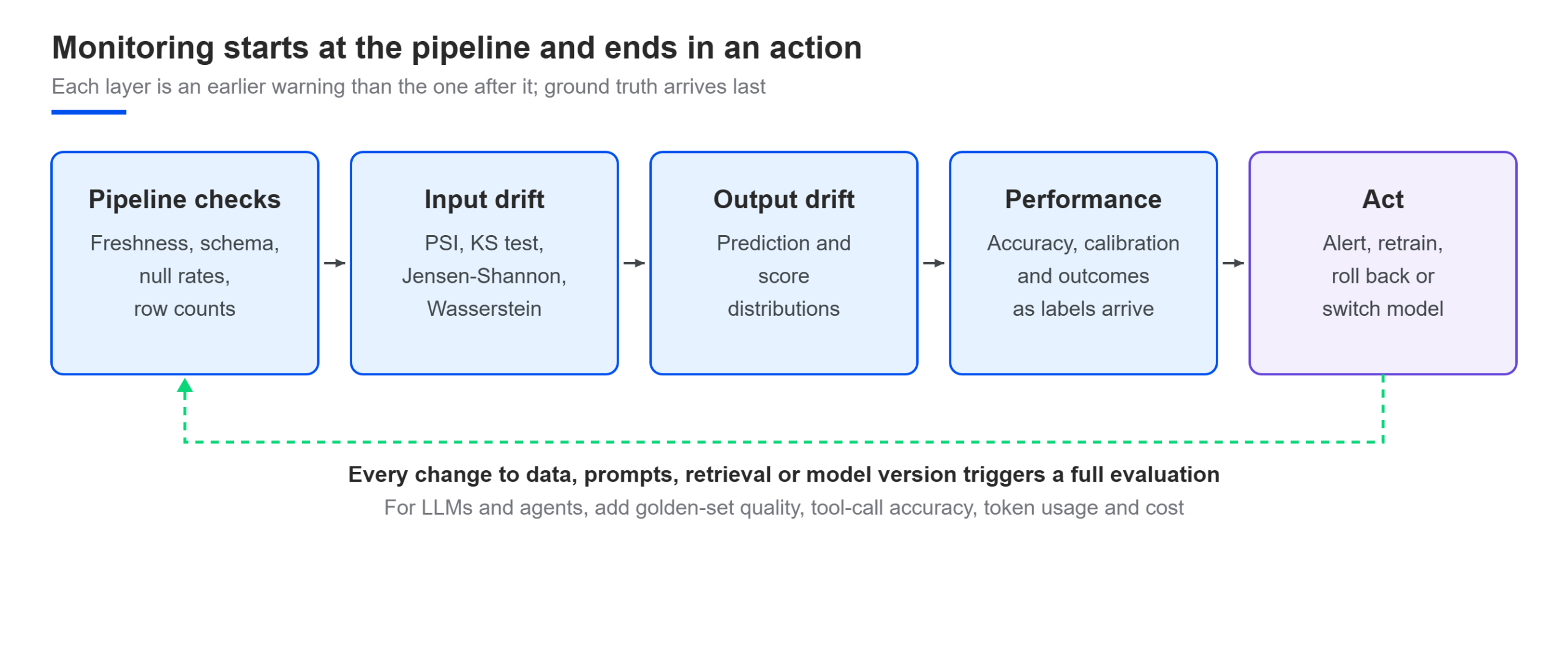
- Input data quality. Before you measure drift, check the data arrived intact: freshness, schema changes, null rates, out-of-range values and row counts. A broken pipeline looks like drift and is cheaper to fix.
- Input drift. Compare each feature’s production distribution with a reference, usually the training set or a recent stable window. Azure ML lists the standard tests: Jensen-Shannon distance, Population Stability Index, normalized Wasserstein distance, the two-sample Kolmogorov-Smirnov test and Pearson’s chi-squared test. The Population Stability Index has the most widely used thresholds: below 0.1 means no significant shift, 0.1 to 0.25 a moderate shift, and above 0.25 a significant shift, per MathWorks’ documentation and a 2025 paper in BMC Medical Research Methodology. Evidently’s defaults are a useful starting point: the Kolmogorov-Smirnov test for numerical features with up to 1,000 rows, Wasserstein distance above that, and a dataset-level alert when half the features drift.
- Output drift. Track the distribution of predictions and scores. A fraud model that flags twice as many transactions this week has either found a fraud wave or lost its calibration, and either way someone needs to look.
- Performance against ground truth. Accuracy, precision, recall, calibration and business outcomes, measured when the real result arrives. Labels often lag by days or months, which is why the first three groups exist: they are the early warning while you wait for the truth.
What to measure for LLMs and agents
Generative systems don’t have a single accuracy number, and the model is usually someone else’s, so model drift monitoring shifts toward behavior, quality and cost. Gartner’s March 2026 recommendation is that observability platforms monitor latency, drift, token usage and cost, and error rates, and it predicts explainability requirements will push LLM observability investment to 50% of GenAI deployments by 2028.
- Quality on a fixed test set. Run a golden set of real prompts with reference answers on a schedule, and score correctness, groundedness and completeness. Microsoft Foundry’s built-in evaluators score groundedness from 1 to 5 using a model-based judge, and its observability model combines continuous evaluation of sampled production traffic with scheduled evaluation on test datasets to detect system drift.
- Behavior in production. Refusal rate, safety flags, escalation rate and, for agents, tool-call accuracy: whether the agent chose the right tool with the right parameters.
- Embedding drift. When the questions users ask change, the retrieval layer and prompts tuned for the old questions degrade. Evidently’s default method trains a classifier to tell reference and current embeddings apart and flags drift when it succeeds too well.
- Operational metrics. Failure rate, latency to first token, token usage per request and cost per completed task. Datadog’s 5% request failure figure is a reasonable baseline to beat.
- Provider changes. Pin model versions, subscribe to deprecation notices and rerun the golden set whenever a provider announces a change, since you can’t see the change any other way.
How often should you measure model drift?
There is no universal schedule for model drift monitoring. Azure ML’s guidance is to monitor daily for models with heavy daily traffic and weekly or monthly otherwise, and AWS SageMaker’s monitoring scheduler supports hourly as its minimum interval. The Federal Reserve’s SR 26-2 says the frequency and scope of monitoring should depend on the nature of the model, the availability of new data and the model’s materiality. A practical starting point:
| Check | High-volume, real-time or high-risk models | Most models | Low-volume batch models |
|---|---|---|---|
| Pipeline and input data quality | Every run or hourly | Daily | With each batch |
| Input and output drift | Hourly to daily | Daily to weekly | Monthly |
| Performance against ground truth | As labels arrive, reviewed weekly | Monthly | Quarterly |
| LLM golden-set evaluation | Daily, plus on every prompt, model or retrieval change | Weekly, plus on every change | On every change |
| Sampled production quality (LLMs) | Continuous | Continuous at a lower sample rate | Weekly sample |
| Cost and token usage | Daily | Weekly | Monthly |
| Full model review | Quarterly | Semi-annually | Annually |
Two triggers override the calendar. Any change to a data pipeline, prompt, retrieval index, model version or provider should trigger a full evaluation before and after, and any alert from the input quality checks should pause drift conclusions until the pipeline is confirmed healthy.
What regulators expect in 2026
Model drift monitoring is now a written obligation in several regulated sectors.
- Banking. The Federal Reserve’s SR 26-2, issued April 17, 2026, supersedes the long-standing SR 11-7 model risk guidance. It describes ongoing monitoring as evaluating “the extent to which a model is performing as expected,” with frequency scaled to materiality. Its footnote excludes generative and agentic AI from scope, so banks need their own standard for those.
- EU. Article 72 of the AI Act requires providers of high-risk AI to establish and document a post-market monitoring system that actively collects and analyzes performance data throughout the system’s lifetime. The June 2026 simplification regulation moved the high-risk deadlines to December 2, 2027, for stand-alone systems and August 2, 2028, for AI embedded in products.
- Medical devices. The FDA’s January 2025 draft guidance on AI-enabled device software notes that devices can be sensitive to data drift and that performance changes “may not be evident to users,” and asks for lifecycle performance monitoring. It remains a draft.
- Everywhere else. The NIST AI Risk Management Framework’s MEASURE and MANAGE functions call for monitoring system behavior in production, with alerts when input distributions differ from pre-deployment testing, and implemented post-deployment monitoring plans.
McKinsey’s 2026 State of AI Trust survey of about 500 organizations found the share reporting AI-related incidents steady at roughly 8%, alongside a gap between the risks organizations consider relevant and those they actively mitigate. The difference between that 8% and OneTrust’s 86% is mostly definition, and it makes the point: an organization only counts the incidents it can see.
Frequently asked questions
What is model drift?
Model drift is the loss of accuracy a model suffers after deployment because the data it sees, or the relationship between that data and the outcome, no longer matches what it was trained on. Data drift, concept drift and prediction drift are the three forms to monitor.
What is a good PSI threshold for drift?
The common convention is that a Population Stability Index below 0.1 indicates no significant shift, 0.1 to 0.25 a moderate shift that merits investigation, and above 0.25 a significant shift that usually calls for retraining. Set thresholds per feature, since some inputs matter far more than others.
How often should you run model drift monitoring in production?
Daily for models with heavy daily traffic, weekly or monthly for lower-volume models, and hourly for high-risk real-time systems. Always run a full evaluation after any change to data pipelines, prompts, retrieval or model versions. Regulators such as the Federal Reserve expect frequency to scale with model materiality.
How do you monitor an LLM for drift?
Keep a golden set of real prompts with reference answers and rerun it on a schedule and after every change. Add continuous evaluation of sampled production traffic for groundedness, safety and tool-call accuracy, watch embedding drift in the questions users ask, and track failure rate, latency, tokens and cost.
Does model drift monitoring replace retraining?
No. Monitoring tells you when to retrain, roll back or switch models, and provides the evidence a regulator or auditor will ask for. Without monitoring, retraining happens on a guess.
Conclusion
Most organizations run AI in production without watching it, and that is where incidents come from. Model drift monitoring that works starts with the data pipeline, measures input, output and performance drift on a schedule matched to traffic and risk, extends to quality, behavior and cost for LLMs and agents, and reruns everything when anything upstream changes. Regulators in banking, the EU and medical devices now expect that discipline in writing.
Explore how our Applied AI practice builds governance into every AI system it ships.
Sources
- BARC, AI is in production at 97% of organizations, but controls lag behind, September 2026 (234 respondents)
- OneTrust 2026 AI-Ready Governance Report, via Intelligent CIO, Eighty-six percent of organisations report AI-related incidents, September 2026 (1,200 decision makers; vendor research)
- Stanford HAI, 2026 AI Index Report: Responsible AI
- McKinsey & Company, State of AI trust in 2026: Shifting to the agentic era, March 2026
- Gartner, By 2028, Explainable AI Will Drive LLM Observability Investments to 50% for Secure GenAI Deployment, March 2026
- Datadog, State of AI Engineering 2026, April 2026 (vendor telemetry)
- OpenAI, Deprecations, and Anthropic, Model deprecations
- Abraham and Bucknall, Silent Updates: Measuring and Closing the Post-Deployment Disclosure Gap, arXiv preprint, August 2026
- Microsoft Learn, Azure Machine Learning model monitoring, Microsoft Foundry observability and built-in evaluators
- MathWorks, Population Stability Index, and Lu et al., BMC Medical Research Methodology, 2025
- Evidently, Data drift methods and defaults, Embedding drift and Concept drift (vendor documentation)
- AWS, SageMaker Model Monitor schedule expressions
- Federal Reserve, SR 26-2: Supervisory Guidance on Model Risk Management, April 2026
- EU AI Act, Article 72: Post-Market Monitoring, and Council of the EU, Artificial intelligence act timeline
- FDA, Artificial Intelligence-Enabled Device Software Functions: Lifecycle Management and Marketing Submission Recommendations, draft guidance, January 2025
- NIST, AI RMF Playbook: Measure and Manage