
If your team is arguing about whether to call the new group “DevOps” or “SRE,” the argument is usually about something else: who is on call, what reliability targets are acceptable, how time gets split between features and operations, and what “done” means for a service that is live. SRE and DevOps answer those questions in overlapping but meaningfully different ways, and the choice is not a style preference. It changes how teams are organized, what gets measured, and who has the authority to stop a release.
This guide sets out the origins, the differences, the overlap and the practical decision: which you need, in which parts of the organization, and how to combine them where both make sense.
DevOps is a culture and set of practices that bring development and operations together so software ships faster without breaking more often. SRE (site reliability engineering) is a specific engineering discipline from Google that runs services against numeric reliability targets, using SLOs, error budgets and a 50% cap on operational work. The short version of SRE vs DevOps: DevOps is how the whole delivery organization works, SRE is how individual services with real reliability stakes are run.
What this guide covers
Key takeaways
- DevOps is a culture and practice; the first DevOpsDays ran in Ghent on October 30 to 31, 2009, inspired by the Allspaw and Hammond “10+ Deploys Per Day” talk at O’Reilly Velocity earlier that year. The focus is breaking the wall between development and operations so software moves faster without breaking more often.
- SRE is a specific engineering discipline Ben Treynor started at Google in 2003, formalized in the 2016 Google SRE book. It is defined by SLOs, error budgets and a 50% cap on operational work (toil).
- The overlap is large: both aim for frequent, reliable deployment, automated infrastructure, shared ownership and measurable reliability, and both now run on the same platform engineering foundation.
- The differences matter: SRE has a specific operating model (SLOs, error budgets, toil budgets, blameless post-mortems) that DevOps leaves up to each team. SRE also has the authority to block a release that spends its error budget.
- Most organizations need both: DevOps as the culture and practice across all delivery teams, SRE as a dedicated discipline for the services where reliability is an explicit product feature.
Where each idea came from
DevOps began as a cultural movement. Patrick Debois organized the first DevOpsDays in Ghent on October 30 to 31, 2009, inspired by a talk earlier that year by John Allspaw and Paul Hammond at O’Reilly Velocity, “10+ Deploys Per Day: Dev and Ops Cooperation at Flickr.” The core insight was that development and operations in most organizations were two separate functions with opposing incentives (ship change versus keep it stable) and that the wall between them was the biggest drag on delivery. DevOps proposed breaking the wall: shared on-call, shared metrics, shared tooling, infrastructure as code, continuous delivery.
SRE started earlier, inside Google, and arrived with a formal definition. Ben Treynor founded the Site Reliability Engineering team at Google in 2003, and the 2016 Google SRE book explains the concept in Treynor’s own words: “SRE is what happens when you ask a software engineer to design an operations team.” The SRE team’s job is to apply software engineering practice to operations: automate the toil, define the reliability target, measure against it, and gate releases on whether the target is being met. The Google SRE book codifies the model, including the famous rule that SREs spend at most 50% of their time on operational work and the rest on engineering.
The two met in the middle through the 2010s. DevOps picked up SLOs and error budgets from the SRE playbook. SRE spread beyond Google through books, conferences and the adoption of Kubernetes, which made the SRE model practical for everyone. In 2026 the vocabulary overlaps a lot, which is why the arguments start.
SRE vs DevOps, in one table
| Dimension | DevOps | SRE |
|---|---|---|
| Origin | Cultural movement, DevOpsDays 2009 | Engineering discipline, Google 2003 |
| Scope | How the whole delivery organization works | How specific services are run in production |
| Team structure | Usually no separate team; practices adopted by delivery teams | Usually a dedicated SRE team embedded with product teams |
| Primary metric | DORA metrics (lead time for changes, deployment frequency, change failure rate, failed deployment recovery time, rework rate) | SLOs (service level objectives) with error budgets |
| Reliability target | Goal rather than hard constraint | Explicit, numeric, agreed with the business |
| Operational-work cap | None defined | 50% maximum, per Google SRE |
| Release authority | Team’s own release process | SRE can block releases that spend the error budget |
| Who owns on-call | Shared, usually the delivery team | Shared between product team and SREs, following the error budget |
The table hides the biggest practical difference: SRE has an operating model. When an SRE team agrees an SLO of 99.9% availability over 28 days with the business, the error budget (how much the service is allowed to be down) is a measurable number, and when it gets spent, releases stop until it is earned back. DevOps does not have an equivalent brake built in.
Where SRE and DevOps overlap
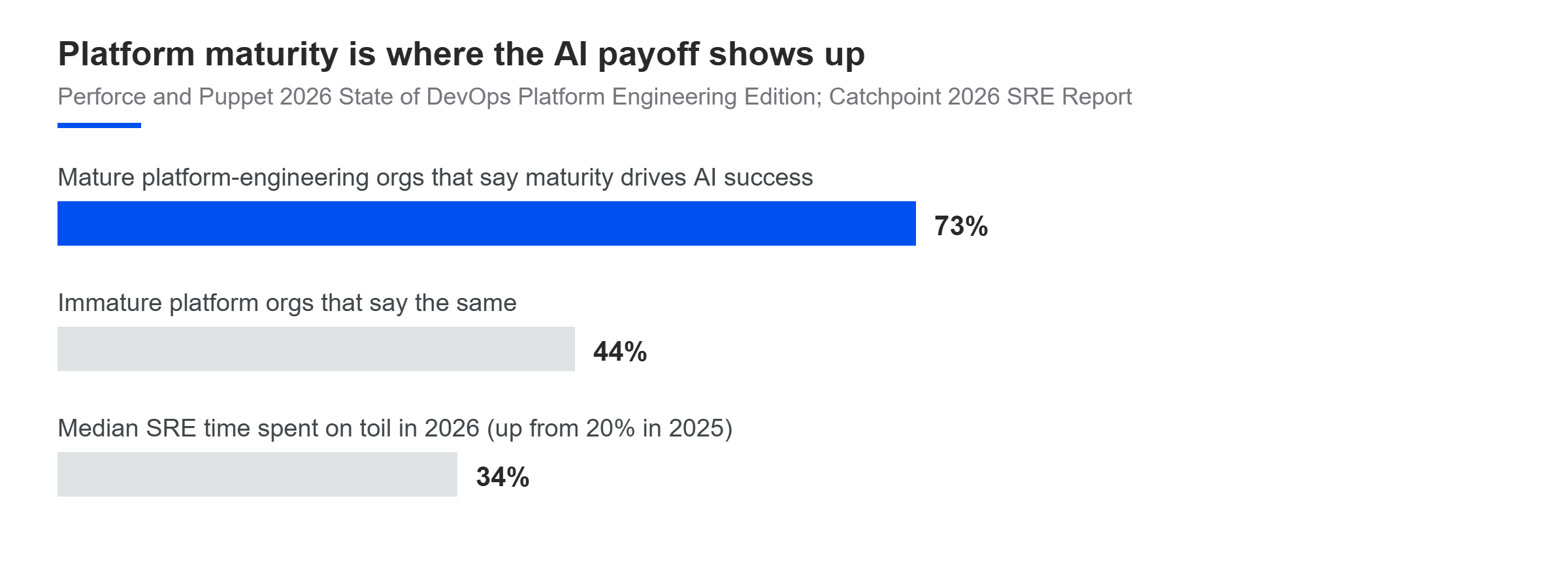
Both aim for frequent deployment, automated infrastructure, shared ownership between developers and operators, telemetry-driven decisions, and blameless post-incident reviews. Both treat software delivery as an engineering problem. Both make heavy use of platform engineering: the 2025 DORA report, based on nearly 5,000 technology professionals, found that 90% of organizations have adopted at least one internal platform and that a high-quality internal platform is “an essential foundation” for AI success. Perforce and Puppet’s 2026 State of DevOps: Platform Engineering Edition echoed the point, with 73% of mature platform-engineering organizations saying maturity drives their AI success, against 44% at immature ones. A modern organization doing either will have a landing zone, CI/CD pipelines, observability, an on-call rotation and infrastructure as code.
The practices are also compatible. A delivery team that practices DevOps can adopt SLOs and error budgets for its most important services without rebranding. An SRE team can work alongside DevOps teams, offering reliability engineering as a shared service.
SLOs and error budgets: the SRE-specific piece
If you take only one thing from SRE and leave the rest, take this: a Service Level Objective (SLO) is a numeric reliability target agreed with the business, and the error budget is one minus that number, expressed as allowed downtime or allowed error rate over a time window. Google’s SRE book makes the point that 100% is the wrong target for almost every service: the gap between 100% and the SLO is the budget the team is allowed to spend on risk, which is how it ships features.
In practice, the SLO gives the team three things DevOps alone does not. It tells engineers how much reliability work is required (above the SLO, more features; below, more reliability work). It gives the business a seat in the reliability conversation (so they stop asking for “100% uptime” and start choosing what the service is worth). And it makes the brake visible: when the budget is spent, releases of risky changes stop until it is earned back, which is far cheaper than finding out through an incident.
The hybrid that works in practice
Most large organizations run both. DevOps is the way delivery teams work: shared ownership, infrastructure as code, continuous delivery, on-call. SRE is a dedicated discipline for the services that have explicit reliability contracts (a customer-facing API, a payments system, a trading platform, an authentication service). The SRE team does not take ownership of operations away from the delivery team; it embeds alongside the team, agrees the SLOs, and helps protect the error budget through design review, capacity planning, incident response and automation.
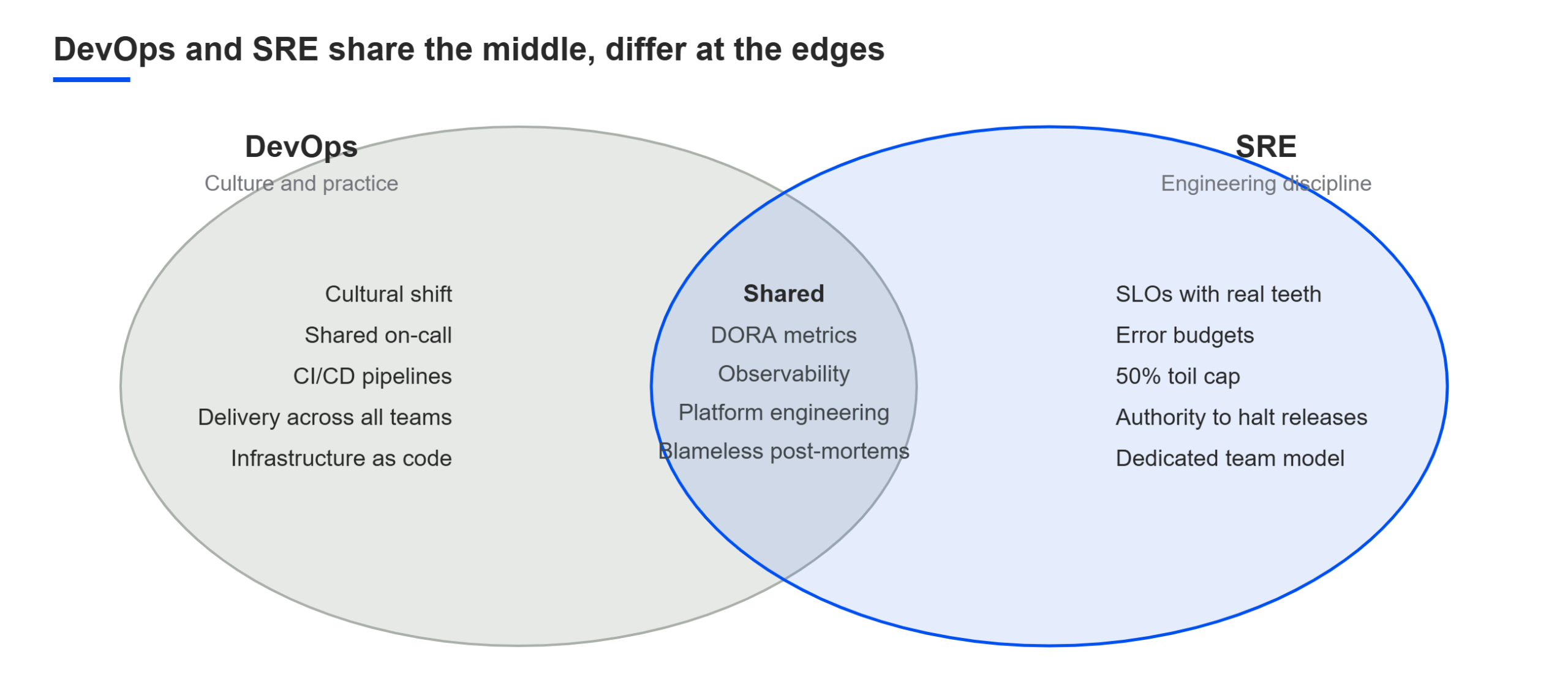
A workable rule: use DevOps everywhere, and add SRE to the services where the business can say in a sentence what the reliability target should be and what it is worth. The 2025 DORA report dropped the old elite, high, medium and low performance tiers in favour of seven team profiles, which is a useful corrective here. There is no single ladder to climb. A team can be stable and methodical, or high impact and low cadence, and the right mix of DevOps practice and SRE discipline is the one that fixes the profile you actually have.
Which you need
- Small or medium team shipping internal applications: DevOps practices are enough. Define a shared on-call, automate the pipeline, set up observability, run blameless post-incident reviews. SLOs are useful once a service has external users with expectations.
- Product organization with customer-facing services and explicit reliability commitments: add SRE for those services. Define SLOs, run them with error budgets, give SRE the authority to slow releases when the budget is spent.
- Platform team supporting many delivery teams: build the platform (landing zone, CI/CD, observability, policy) that both DevOps and SRE practices run on. Gartner predicted in 2023 that by 2026, 80% of software engineering organizations would establish platform teams as internal providers of reusable services, and that is the role being described.
- An SRE team doing more operations than engineering: the Google SRE 50% rule is the yardstick. If SREs spend more than half their time on toil, something is wrong with the model: either the team is understaffed, the services are not instrumented, or the delivery teams are pushing operational work across the boundary. Catchpoint’s 2026 SRE Report found median reported toil had risen to 34% of SRE time (up from 20% a year earlier), which is a warning that even disciplined teams are being pulled in the wrong direction.
How Compunnel Digital helps
Compunnel Digital builds the platforms and runs the operations that DevOps and SRE depend on.
- Managed SRE and AIOps runs SRE as a managed service: SLO design, error budget operation, incident response with AIOps-assisted correlation, and 24×7 on-call. Compunnel reports 99.98% service availability for a global retail platform.
- Cloud migration and modernization builds the underlying platform through cloud-native engineering, migration automation and platform modernization frameworks.
- Cloud-native accelerators: PlatformX™ supplies microservices patterns, containerization templates, Kubernetes orchestration frameworks and event-driven architecture blueprints. ShieldCI™ embeds security gates into CI/CD pipelines. SecureLanding™ provides secure landing zones as infrastructure as code. Compunnel reports 40% faster migrations and 10x faster environment provisioning with these accelerators.
- Automation modernisation rebuilds the test automation that DevOps delivery depends on, with self-healing automation and AI-driven test generation. Compunnel reports an 80% reduction in automation maintenance and a threefold increase in tester productivity.
If you are standing up a DevOps or SRE practice, deciding which services deserve SLOs, or trying to get more out of a practice that already exists, talk to our team.
Frequently asked questions
What is the main difference between SRE and DevOps?
DevOps is a culture and practice that brings development and operations together. SRE is a specific engineering discipline (originated at Google) that applies software engineering to operations, with SLOs, error budgets and a 50% cap on operational work. DevOps is how the organization works. SRE is a role and a model for running specific services.
Is SRE a type of DevOps?
Both the Google SRE book and Google Cloud describe SRE as one implementation of DevOps principles, specifically the one Google developed before DevOps had a name. They are compatible rather than opposed.
Do SRE and DevOps use the same tools?
Largely yes: both depend on CI/CD pipelines, infrastructure as code, observability platforms, on-call tooling and the same cloud platforms. SRE adds SLO management tooling (Nobl9, Google’s SLO calculator, Datadog SLOs, Grafana SLOs) on top.
Which is better, SRE or DevOps?
They are not alternatives for the same job. Most organizations need DevOps as a practice across all delivery teams and SRE as a dedicated discipline for services with explicit reliability contracts.
What is an error budget?
An error budget is the maximum amount of unreliability a service is allowed in a given time window, derived from its SLO. Google’s SRE book defines it as “one minus the availability target.” If the SLO is 99.9% availability over 28 days, the error budget is about 40 minutes of downtime; when the budget is spent, releases of risky changes stop until it is earned back.
Conclusion
SRE and DevOps are not competing products to pick between; they are complementary answers to overlapping questions. DevOps is the culture and practice across delivery teams; SRE is the engineering discipline that runs services with explicit reliability contracts. Pick DevOps as the way the organization works, add SRE to the services that have real reliability stakes, build the platform that both depend on, and measure DORA and SLOs so the reliability conversation stays numeric.
Explore how our Cloud, Platforms and Engineering practice builds the platforms and runs the operations SRE and DevOps depend on.