
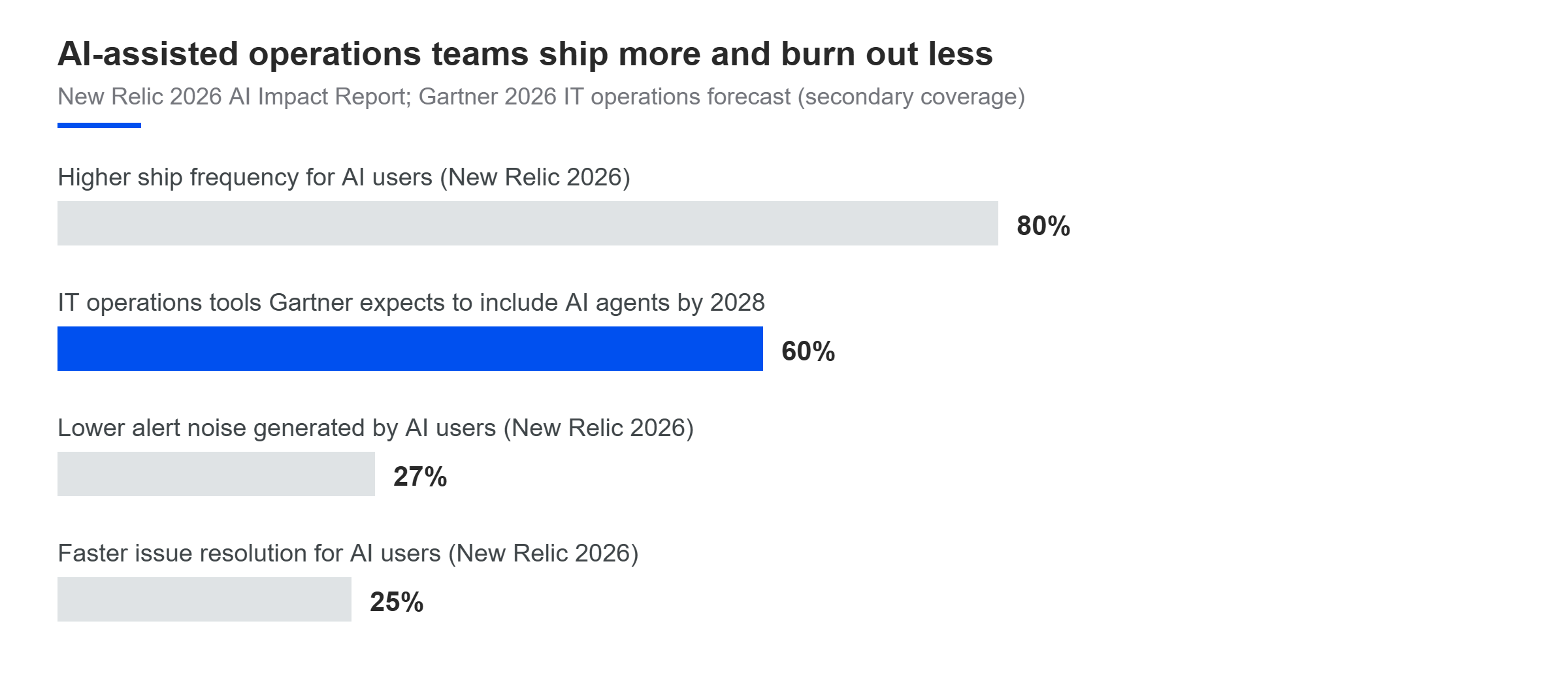
Every IT operations team is now drowning in signal. A modern cloud-native estate generates billions of metric data points, millions of log lines and hundreds of thousands of traces a day, and the humans on the on-call rotation are expected to read all of it. AIOps is the industry’s answer: apply machine learning to the telemetry so the humans see only what matters, and automate the response where the pattern is clear. Gartner, which coined the term in 2016, now predicts AI agents will be implemented in 60% of IT operations tools by 2028. The 2025 and 2026 investment cycle has moved from “which vendor” to “which use cases first.”
This guide defines the term, lists the use cases that pay back, surveys the 2026 platform landscape, and lays out the order in which to put it in place. If you are planning an AIOps program or trying to extract more value from a tool you already own, start here.
AIOps (Artificial Intelligence for IT Operations) is the use of machine learning and automation on IT operations data (metrics, logs, events, traces and tickets) to cut alert noise, find the cause of incidents faster, and automate the responses that follow a clear pattern. Gartner coined the term in 2016 and names big data and advanced analytics as its two technology pillars.
What this guide covers
Key takeaways
- AIOps is the application of machine learning and automation to IT operations data: metrics, logs, events, traces and tickets. Gartner’s original definition names “big data” and “advanced analytics” as the two technology pillars.
- The five industry-standard use cases that pay back are anomaly detection, event correlation, causal analysis, incident automation and capacity and performance forecasting. Most programs start with event correlation because it has the clearest first-year savings.
- The 2026 platform landscape has consolidated. ISG’s 2026 Buyers Guide puts ServiceNow and Dynatrace at the top, with BMC, Cisco (Splunk), Datadog, Elastic, IBM and PagerDuty in the tier below. Most organizations now buy AIOps as part of an observability or ITSM platform instead of as a separate tool.
- Observability data quality is the prerequisite. An AIOps platform run on inconsistent telemetry produces inconsistent conclusions, so most programs start with a telemetry audit (standard metric names, trace propagation with OpenTelemetry, structured logs) before the first ML model is turned on.
- GenAI has changed the interface. Gartner predicts AI agents will be implemented in 60% of IT operations tools by 2028, and New Relic’s 2026 AI Impact Report found AI users resolved issues about 25% faster and generated 27% less alert noise than peers.
What AIOps is, in plain terms
Gartner defined AIOps in 2016 as “platforms [that] utilize big data, modern machine learning and other advanced analytics technologies to directly and indirectly enhance IT operations.” A decade in, the clearer definition is this: AIOps is the set of techniques that take the firehose of IT operations data and turn it into a small number of actionable signals, with the response automated where the pattern is clear.
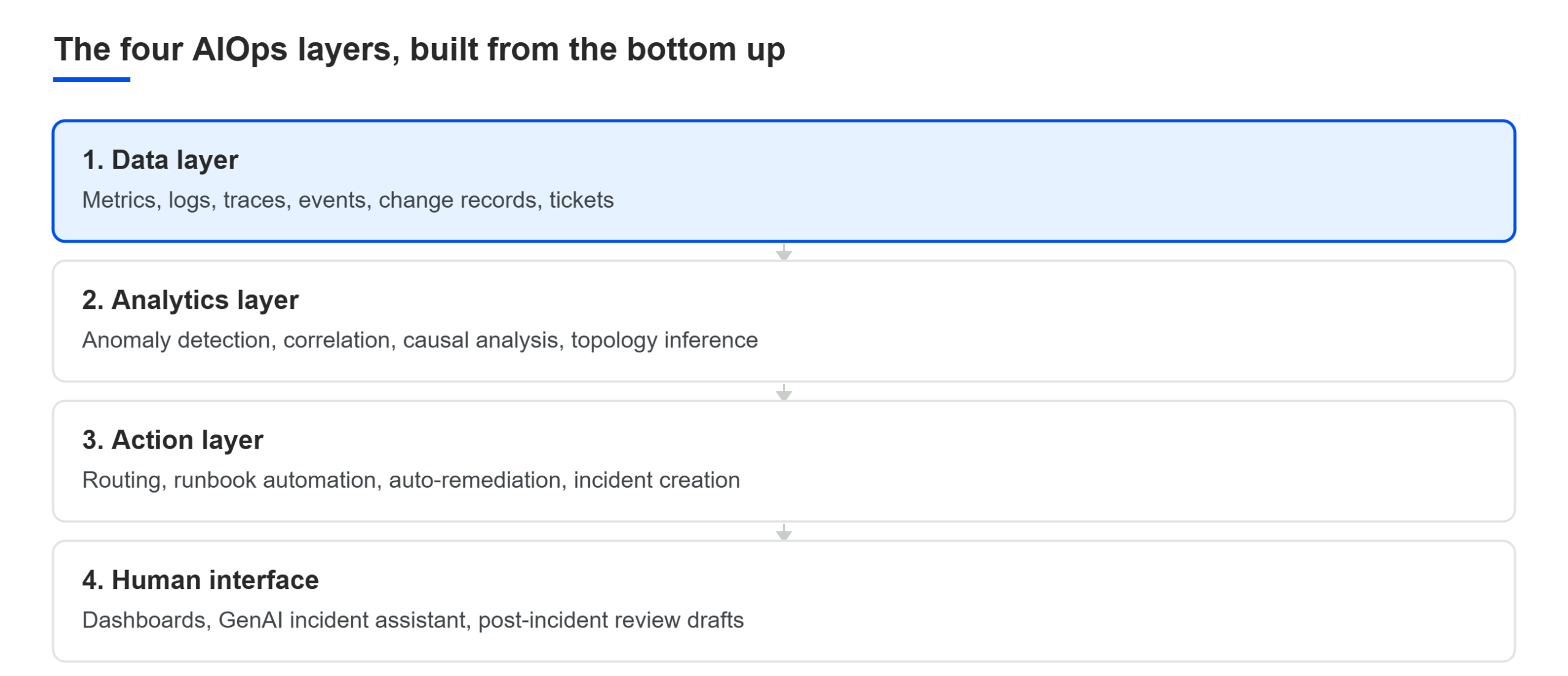
A useful way to think about the layers:
- Data layer: metrics, logs, traces, events, change records, tickets, chat transcripts. OpenTelemetry has become the open standard for most of this; CNCF announced its graduation in May 2026, calling it the second-highest-velocity CNCF project with more than 24,000 contributors.
- Analytics layer: anomaly detection on metrics, log clustering, event correlation, causal analysis, topology inference and incident grouping.
- Action layer: notification routing, runbook automation, auto-remediation, incident creation and post-incident review drafting.
- Human interface: dashboards, incident timelines, a natural-language assistant that answers “what changed before this broke.”
Most organizations arrive here from one of three directions: an observability program that outgrew human review, an ITSM program drowning in alerts, or an SRE program trying to protect error budgets. The direction they arrive from decides which platform they pick first.
The five AIOps use cases that pay back
Gartner retired its separate AIOps Platforms Market Guide after the 2022 edition and now publishes a Market Guide for Event Intelligence Solutions instead, which covers similar ground. Across that research, vendor documentation and analyst summaries, five use cases consistently show up as the ones with the clearest return:
- Anomaly detection. Statistical and ML models watch metrics and logs for behavior outside their normal range, without the team having to write a static threshold for every service. Reduces alert noise immediately.
- Event correlation. The platform groups related alerts into incidents. A server failing takes 40 downstream services with it; event correlation turns that into one incident instead of 41, which is where the first-year productivity gains come from. The cost of not doing this is measurable: Splunk’s State of Observability research, reported by ITPro in January 2026, found 75% of UK IT teams had an outage in 2025 caused by an alert that was ignored or suppressed, and 15% admitted suppressing alerts deliberately.
- Causal analysis. Topology-aware tools point at the component most likely to be causing an incident, often by walking the service dependency graph backward from the symptom. Cuts MTTR because the on-call engineer starts in the right place.
- Incident automation. Runbooks run automatically against known incident patterns: restart the pod, failover the replica, open a ticket with the right context already attached. Tiered carefully (suggest, then approve, then auto) so humans stay in the loop on anything consequential.
- Capacity and performance forecasting. ML models on time-series data predict when a resource will run out or a service will miss its SLO, days or weeks ahead. Moves capacity planning from quarterly to continuous.
Programs that try to do everything at once usually stall. Pick the use case where the gap between current state and ML-assisted state is widest (almost always event correlation) and prove the value there before adding the next one.
The 2026 AIOps platform landscape
The market has consolidated since the early days of standalone AIOps products. Most organizations now buy it as part of an observability or ITSM platform rather than as a separate tool.
| Platform | Primary strength | Typical buyer |
|---|---|---|
| Dynatrace | Full-stack observability with Davis AI for automatic causal analysis | Enterprises with large Kubernetes estates |
| Datadog | Breadth of integrations, Watchdog anomaly detection, Bits AI assistant | Cloud-first organizations |
| Splunk (Cisco) | Log-centric AIOps, strong security and ITSI for IT service correlation | Large enterprises with regulatory load |
| IBM Concert (with Instana and Cloud Pak for AIOps) | Agentic platform that unifies tools across apps, infrastructure, network and security; Instana ships inside it as Concert Observe | IBM-heavy estates, mainframe-plus-cloud |
| BMC Helix | ITOM plus ITSM integration, event management heritage | Service-management-led buyers |
| PagerDuty | Incident response workflow with AIOps event correlation | On-call-heavy engineering teams |
| ServiceNow Predictive AIOps | AIOps inside ITSM, incident creation and routing; top of ISG 2026 leader rankings | ServiceNow-standard enterprises |
| New Relic | All-in-one observability with built-in anomaly detection and the New Relic AI assistant | Mid-market cloud-native teams |
| Dell APEX AIOps (formerly Moogsoft) | Vendor-neutral event correlation over multiple monitoring sources | Multi-tool estates needing a correlation layer |
Honorable mentions: LogicMonitor for MSP-friendly infrastructure monitoring with AIOps; BigPanda and Grafana Cloud for event correlation and observability respectively; and the hyperscalers’ own tools (Azure Monitor, AWS CloudWatch anomaly detection, Google Cloud Operations) carry enough AIOps to cover a single-cloud estate without a third-party platform.
Which platform fits depends less on features in isolation and more on where the operations team already lives. An observability-led team buys Dynatrace, Datadog or New Relic. An ITSM-led team buys ServiceNow or BMC. An incident-response-led team buys PagerDuty. An IBM-standard enterprise buys Concert. The cost of a mismatch is not the license; it is the integration work that never gets finished.
How to get started with AIOps
A workable sequence for the first year:
- Audit the telemetry. Standardize metric names, add trace propagation through OpenTelemetry, structure logs with consistent fields, and remove the noisy alerts nobody reads. A platform fed inconsistent data produces inconsistent conclusions.
- Turn on anomaly detection and event correlation. These are the highest-value and lowest-risk first moves. Run them against production data in observation mode for two to four weeks before they reach the on-call rotation.
- Pick five runbooks to automate. Choose incidents that happen weekly, have a clear remediation, and are low-blast-radius. Start with “suggest” automation (the platform recommends, a human approves), move to “approve” (one-click apply), and only move to “auto” once the pattern has proved itself.
- Hook into the incident process. Route AIOps-grouped incidents into the on-call tool, with the suspected root cause and change history attached. Measure MTTR before and after; this is where the business-visible gain shows up.
- Add the GenAI incident assistant. Natural-language summaries of what changed, probable-cause ranking and post-incident-review drafts are now table stakes in the major platforms and the single biggest hour-saver for senior engineers.
Programs that skip step one usually have to redo it anyway, and the detour costs a quarter. Programs that go to step three too fast cause an outage with a bad auto-remediation and lose the organization’s confidence for a year.
What GenAI has changed
Every serious AIOps product now has a natural-language layer: Dynatrace Davis CoPilot, Datadog Bits AI, Splunk AI Assistant, IBM Concert, ServiceNow Now Assist, PagerDuty Incident Co-pilot and New Relic AI (launched in 2023 as New Relic Grok). The pattern is similar across them: the assistant drafts the incident summary, lists the recent changes correlated with it, suggests probable causes and drafts the post-incident review. The business-visible gain is measurable. New Relic’s 2026 AI Impact Report found AI users resolved issues roughly 25% faster than peers and generated 27% less alert noise, and the SolarWinds 2025 State of ITSM report found generative AI in service-desk workflows cut average incident resolution time by 17.8%, saving about 4.87 hours per ticket.
Two cautions carry over from the playbook of the last decade. The assistant’s suggestions are only as good as the telemetry and topology behind it, so skipping step one still hurts, just in a new way. And an automated remediation that is wrong on the wrong incident does more damage than a manual one that is slow, so GenAI does not change the tiering logic in step three. It gives the on-call engineer a better co-pilot, not a replacement. Gartner’s forecast that AI agents will be implemented in 60% of IT operations tools by 2028 still assumes humans on the gate.
How Compunnel Digital helps
Compunnel Digital builds and runs AIOps programs end-to-end, with managed services for the day two operation and accelerators for the parts of the work that repeat.
- Managed SRE and AIOps covers observability platform design, ML-assisted event correlation, runbook automation, SLO and error budget operation, and 24×7 incident response. Compunnel reports a 72% reduction in critical incidents for an enterprise SaaS provider.
- Cloud migration and modernization sets up the observability and telemetry foundations that AIOps depends on, as part of cloud-native engineering and platform modernization.
- Cloud-native accelerators: PlatformX™ supplies observability and platform engineering patterns; ShieldCI™ embeds security gates and detection into CI/CD pipelines; FinOpsVision™ adds cost anomaly detection and forecasting on top of the cloud bill. Compunnel reports 10x faster environment provisioning and 15% lower total cloud spend with these accelerators.
If you are trying to get more from an AIOps tool you already own, or planning a new one, talk to our team about an assessment.
Frequently asked questions
What is AIOps?
AIOps (Artificial Intelligence for IT Operations) is the application of machine learning and automation to IT operations data, including metrics, logs, events, traces and tickets. The goal is to reduce alert noise, speed up incident response, and automate the parts of operations that follow a clear pattern. Gartner coined the term in 2016.
What are the main AIOps use cases?
Anomaly detection, event correlation, causal analysis, incident automation and capacity forecasting. Most programs start with event correlation because it has the clearest first-year productivity gain.
What are the leading AIOps platforms?
Dynatrace, Datadog, Splunk (now Cisco), IBM, BMC Helix, PagerDuty, ServiceNow Predictive AIOps, New Relic and Dell APEX AIOps. The right choice depends on where the operations team already lives (observability, ITSM or incident response), which the comparison table above sets out.
Is AIOps the same as observability?
No. Observability is the discipline of collecting and interpreting the telemetry (metrics, logs, traces) that lets you answer questions about a running system. AIOps applies machine learning and automation on top of that data, including other sources such as events and tickets. Most organizations need both, and AIOps depends on observability being done well.
How long does an AIOps program take to pay back?
For most programs, event correlation and anomaly detection start paying back within two to three months of reaching production, in reduced alert volume and faster incident triage. Runbook automation and causal-analysis gains show up over six to twelve months.
Conclusion
AIOps is not a product; it is a set of capabilities layered on top of good telemetry. Start with event correlation and anomaly detection, build a small automation library once the data is clean, add the GenAI incident assistant that your platform now ships with, and measure MTTR against the baseline. The buyers who do this in sequence see the productivity gains in the first year; the ones who buy a platform and expect it to be the answer usually do not.
Explore how our Cloud, Platforms and Engineering practice builds and runs AIOps estates end-to-end.
Sources
- Gartner, AIOps Platforms market definition and Market Guide
- CNCF, Annual Cloud Native Survey, January 2026
- OpenTelemetry, Project page and annual review
- Dynatrace, Davis CoPilot overview
- Datadog, Watchdog and Bits AI overview
- Splunk and Cisco, Splunk IT Service Intelligence (ITSI)
- IBM, AIOps portfolio: Instana, Cloud Pak for AIOps and Concert, and Think 2026 DevOps recap, May 2026
- BMC Software, Helix AIOps
- PagerDuty, AIOps overview
- ServiceNow, Predictive AIOps
- New Relic, 2026 AI Impact Report, January 2026, and New Relic AI
- Dell APEX AIOps (formerly Moogsoft), Dell APEX AIOps
- ISG, Buyers Guide for AIOps Platforms 2026, June 2026
- Gartner, AI agents forecast via secondary coverage, 2026
- SolarWinds, 2025 State of ITSM Report, via Network World, October 2025
- Splunk, State of Observability 2025, via ITPro, January 2026